Shopping cart is empty.
Total (USD):$10.00
Checkout
 $ USD
$ USD
More Than an Omega Constellation Homage: The Baltany S4106 and the Return of True Vintage Proportions
Introduction: Reinterpreting Vintage Classics through Modern Craftsmanship is Baltany's Enduring Vision
For Baltany, "vintage" is never merely a simplistic imitation of historical forms, nor is it a superficial "nostalgic expression" confined to outward symbols. We prefer to approach it as a continuous design methodology: fully grasping the proportions, silhouettes, dial harmony, and aesthetic zeitgeist of classic timepieces, and then reinterpreting the details truly worth preserving through the lens of modern watchmaking capabilities.
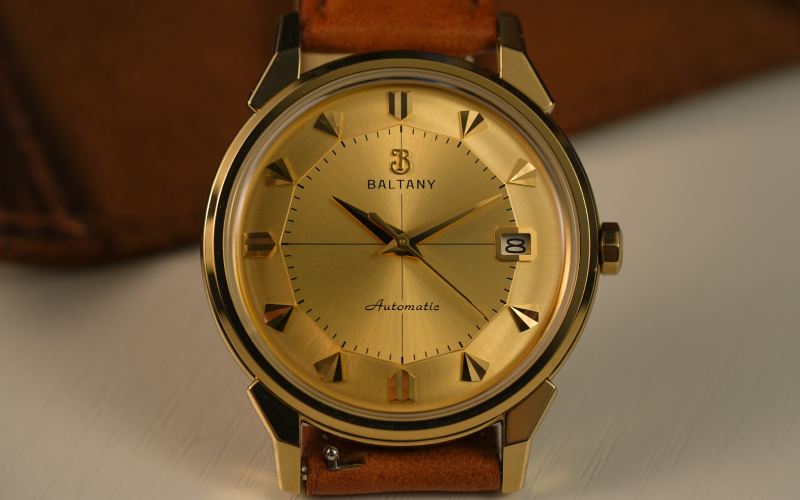
Over the past decade or so, the global haute horlogerie and independent watchmaking sectors have witnessed a sustained wave of "Neo-Vintage" revival. This affirms a fundamental truth—classic designs are never obsolete; people simply desire their return in a manner that better aligns with contemporary wearability and modern manufacturing standards.
The return to classic sizing is a paramount aspect of this trend. For a long time, the watch market was dominated by larger sizes, with case diameters exceeding 40mm becoming the prevailing mainstream. However, we have always believed that the true allure of compelling dress watches and classic everyday timepieces does not rely on an exaggerated presence, but rather on restraint, balance, and an ergonomic fit on the wrist.
36mm is one of the quintessential "golden sizes" within this aesthetic of vintage proportions. It is not being revived merely to pander to a sentimental vintage trend, but because it inherently possesses a visual harmony and a logic of wearability that have stood the test of time.
It is precisely guided by this philosophy that we introduce the Baltany S4106. Its core inspiration stems from one of the most recognizable and historically significant classics in horological history—the 1960s Omega Constellation "Pie-Pan," specifically the Ref. 168.005 generation.
For us, this is not a simplistic "homage" project, but a systematic deconstruction and reconstruction of the classic dress watch architecture. We sought to preserve the three-dimensional depth of the Pie-Pan dial, the unique elegance inherent to Constellation-style timepieces, and the distinctive geometric tension characteristic of dress watches from that era. Concurrently, by leveraging modern materials science, CNC precision machining, and advanced surface treatments, we empower these historical designs with more robust physical performance and a flawlessly modernized wearing experience.
Historical Origins: The Birth, Evolution, and Chronometer Glory of the Omega Constellation
To truly grasp the design philosophy and cultural underpinnings of the Baltany S4106, one must first look to the profound historical origins of its muse: the Omega Constellation series. The Constellation is not merely the flagship dress watch line in Omega’s history; it is a microcosm of the mid-20th-century Swiss watchmaking industry’s relentless pursuit of ultimate chronometric precision and its participation in the fierce observatory chronometer competitions.
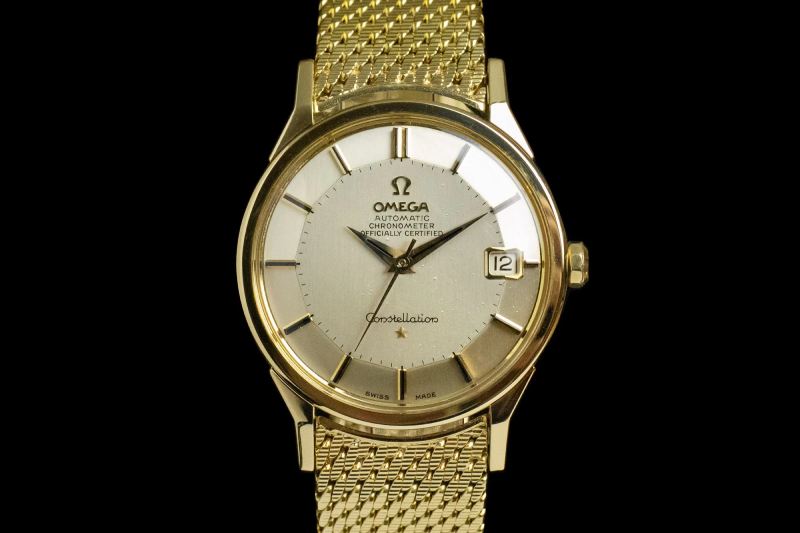
The Centennial Celebration and the Pioneering Legacy of the "Centenary"
The pure lineage of the Omega Constellation can be traced back to 1948. In that year, to commemorate the 100th anniversary of the brand’s founding (established by watchmaker Louis Brandt in 1848), Omega launched a limited-edition luxury timepiece named the "Centenary." Designed by the renowned horological designer René Bannwart (who would later found another celebrated Swiss watchmaker, Corum), this model was the first automatic watch in Omega’s history to receive official Chronometer certification.
The Centenary series was initially produced in a limited run of 6,000 pieces:
- 2,000 pieces equipped with the 28.10mm caliber
- 4,000 pieces equipped with the 30.10mm caliber
Exclusively crafted in solid gold, these pieces represented the pinnacle of luxury and precision for the brand at that time. Following the collection's unprecedented commercial success and immense global acclaim, Omega’s management astutely recognized a substantial, sustained demand within the high-end global market for elegantly designed, hyper-accurate chronometer timepieces.
This pivotal commercial and technical insight directly catalyzed the official and independent birth of the Constellation collection four years later, in 1952.
Bridging the Gap Between Past and Present
Therefore, the S4106 is not merely a reproduction of a vintage aesthetic; it is a creation driven by the proposition of "how to make classics genuinely suitable for the modern wearer." From the deliberate return to a 36mm size, to the introduction of a 500HV surface hardening process; from the interplay of light and shadow on the dial—created by the multifaceted date window, the distinctive faceted indices, and the curved hands—to the three-dimensional silhouette achieved through the complex polishing of the lyre-lug case. We strive to restore the visual essence of the golden era in every single detail, while simultaneously resolving the inherent limitations of vintage watches regarding durability, manufacturing consistency, and long-term reliability.
What the Baltany S4106 represents is more than our interpretation of a specific historical masterpiece; it embodies Baltany's enduring product philosophy: to respect the classics, to study the classics, but never to merely copy the classics. We hope that through modern watchmaking craftsmanship, we can breathe new life into those elegant proportions and design languages that were once confined to the collector's world, ensuring they are not only admired from afar but also truly enjoyed as daily wear.
The Symbolic Significance of the Eight Stars and the Geneva Observatory Medallion
Since the inception of the Constellation series in 1952, its most prominent and culturally totemic hallmark has been the finely engraved Geneva Observatory cupola medallion on the case back, crowned by a constellation of eight gleaming stars. This design served as more than just a brand hallmark against counterfeiting; it was a tangible manifestation of Omega's absolute dominance in the realm of precision chronometry.
These eight stars are not merely arbitrary decorations; they carry rigorous historical significance. They represent the eight exacting world records for chronometric precision that Omega set at the Kew-Teddington Observatory in the United Kingdom and the Geneva Observatory in Switzerland between 1933 and 1952. Notably, during the Kew-Teddington Observatory trials in 1933 and 1936, Omega shattered world records across all precision testing categories, demonstrating exceptional technical prowess in resisting extreme temperature variations and multi-positional errors.
Consequently, from its very beginning, the Constellation was never a product line driven solely by aesthetic design; it was an ultimate timepiece collection with "precision and the highest standard of chronometer certification" as its core soul. It delivered a silent promise to every wearer: this is not just a watch that tells time, but a precision measuring instrument representing the zenith of human micro-mechanical engineering of its era.
The Geometric and Aesthetic Revolution of the "Pie-Pan" Dial
Among the myriad classic design elements of the Constellation series, the most celebrated by global watch collectors and the most visually recognizable is undoubtedly its iconic "Pie-Pan" dial structure. This distinctive design typically features a three-dimensional, domed structure with 12 facets, earning its name because, when inverted, it resembles the undulating edges of a traditional Western baking pan.
The advent of the Pie-Pan design completely shattered the conventional framework of watch dials prior to the 1950s, which were generally flat, two-dimensional, and monotonous. Through the gentle elevation of the central area and the sharp, downward slope of the peripheral chapter ring, the Pie-Pan dial constructs a miniature three-dimensional stage with physical depth and a rich interplay of light and shadow within the highly confined space of the watch case.
When natural or artificial light strikes the dial from different angles, the 12 sloped facets produce an endlessly shifting, alternating play of light and dark reflections, dramatically enhancing the watch's visual depth, dimensionality, and sense of luxury. This design possesses not only immense pure aesthetic value but also posed a monumental challenge to the dial manufacturing techniques of the time. It demanded incredibly precise stamping of the brass base, flawless application of uniform sunburst finishing, and exceptionally meticulous mounting of the applied indices.
A Masterpiece of the Golden Age: An In-Depth Technical Deconstruction of the Omega Constellation Ref. 168.005
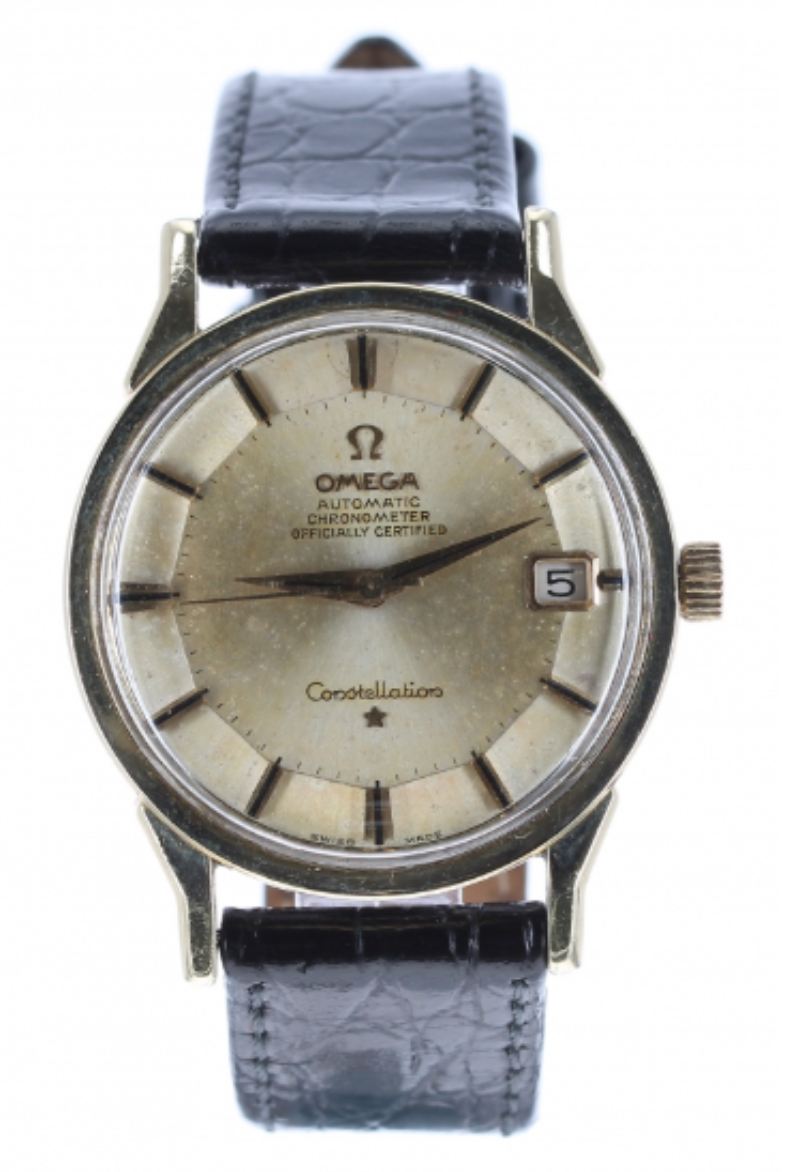
During the first two decades following the birth of the Constellation series—an era widely recognized by horological historians as the "Pie-Pan Era"—Omega released numerous breathtaking classic models. Among them, the Ref. 168.005, introduced in the early 1960s (circa 1962–1963), is widely regarded as one of the most representative, maturely designed, and perfectly proportioned pinnacles in the history of the Constellation line. The Baltany S4106 draws deeply upon the geometric core and aesthetic essence of this exact model.
The Era's Benchmark for Specifications and Movement Craftsmanship
The classic physical dimensions of the Ref. 168.005 were set at a 34mm case diameter, approximately 10.5mm in thickness, and an 18mm lug width. In that elegant era, 34mm was the standard and considered the most flawless size for a men's dress watch; it could tuck away unobtrusively and elegantly beneath the cuff of a tailored French shirt, revealing its brilliance only at the turn of the wrist. The watch crystal utilized resin acrylic (Plexiglass), a popular material at the time. Although prone to physical scratches, its inherent warm, reflective texture and the highly domed distortion effect at the edges are indispensable, soulful visual elements of a vintage watch.
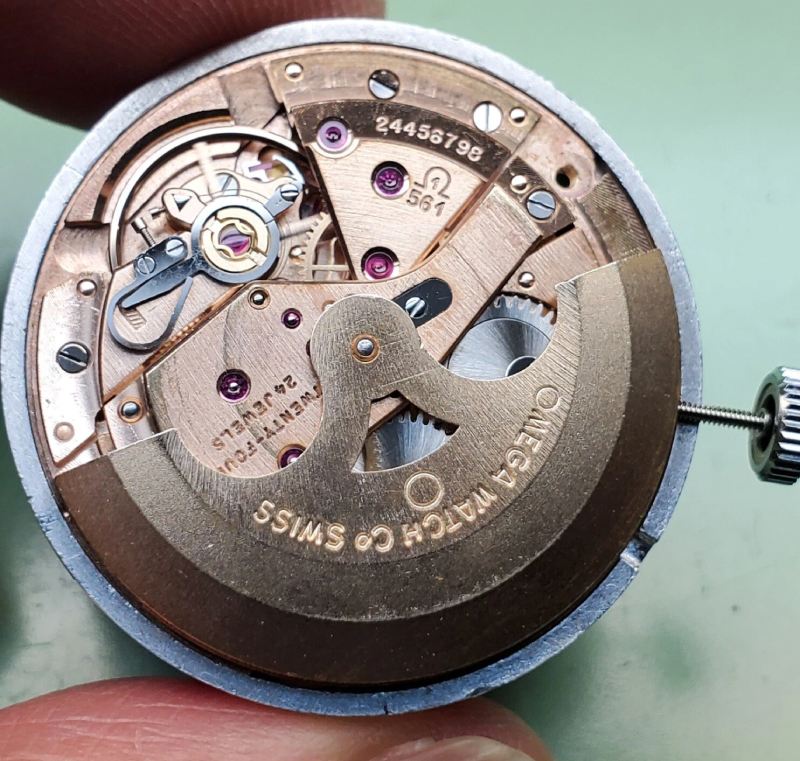
Powering this mechanical heart, the Ref. 168.005 was equipped with Omega's pride, the Caliber 561 (or, later in its life cycle, the Caliber 564 with a quick-set date function) automatic movement. This was a high-end caliber rigorously tested and certified by the Official Swiss Chronometer Testing Institute. The movement's base plates and bridges featured Omega's signature copper plating process. This treatment not only served a practical anti-corrosion function but also imbued the movement with a warm, noble rose-gold hue, offering exceptional functional mechanical beauty and artistic appeal. The Cal. 561 movement delivered stable, reliable, and long-lasting timekeeping, showcasing Omega's outstanding industrial capability in mass-producing ultra-high-precision movements through its intricate swan-neck regulator.
Signature Design Language: The Pie-Pan Dial, "Kite-Shaped" Markers, and Curved Dauphine Hands
The dial display system of the Ref. 168.005 is the focal point of its core charm. It featured a De Luxe version of the Pie-Pan design. The dial was typically printed with a highly instrument-like crosshair layout, precisely dividing the dial into four quadrants, further enhancing the visual metaphor of chronometric precision and the rigor of a scientific instrument.
Regarding the geometric design of the hour markers, this model utilized hand-riveted, faceted solid gold applied markers. One of the most classic and sought-after variations is vividly referred to by modern Chinese watch collectors as "fly-shaped markers" (known internationally as Arrowhead or Kite-shaped markers). These markers present a three-dimensional, multi-faceted arrowhead shape, where every minute facet is polished to capture and reflect even the faintest light. Paired with similarly chamfered and high-polished dauphine hands, it created a sharp, gorgeous, and distinctly period-accurate reading interface.
Even more worthy of in-depth study are the optical engineering considerations: to accommodate the sloped angle of the Pie-Pan periphery and the sharp physical curvature of the domed acrylic crystal's edge, the tips of both the minute and second hands were subjected to a precise, physical bending process. These downward-curved tips not only effectively eliminated the parallax error a wearer might experience when viewing the dial from the side or at an angle, but also visually and geometrically integrated perfectly with the dial's domed structure, demonstrating the meticulous engineering considerations that watchmakers of that era dedicated to micro-optics.
The Evolution of Lug Geometry: From Dog-Leg to Lyre Lugs
The three-dimensional geometry of the case exterior, particularly the design of the lugs, is an important classification basis for identifying different historical periods and specific models within the Constellation series. The Ref. 168.005, along with many core models of the same period, is primarily world-renowned for its famous "Dog-Leg" lugs. Dog-leg lugs possess distinct angularity and sharp, rigid folds, resembling the hind leg joint of a canine, presenting a robust silhouette with a strong sense of industrial sculpture.
However, in the subsequent historical evolution of the Constellation line and other famous Omega collections (such as the Speedmaster and Seamaster), "Lyre Lugs" (also referred to in some contexts as Twisted Lugs) gradually matured and ultimately became one of the brand's most recognizable case DNA signatures. Lyre lugs perfectly combine brushed finishes on the sides with high-polished finishes on the front through an elegant, complex inward-and-outward twisting surface, creating an incredibly intricate and mesmerizing transitional zone of light and shadow.
Tribute and Reshaping Through Modern Craftsmanship: How We Built the Baltany S4106
After deeply understanding the historical status, design spirit, and classic proportions represented by the Omega Constellation Ref. 168.005, we grounded our thinking in the Baltany S4106 itself. For us, the S4106 is by no means a "vintage piece" that stops at mere surface silhouettes. Its true significance lies in how to re-examine and respond to the aesthetic essence of golden-era dress watches using modern watchmaking techniques, crafting a piece that genuinely stands on its own under today's wearing environments, material conditions, and manufacturing capabilities.
Beyond Simple Replication: A Systematic Reconstruction
Therefore, the S4106 is not a simplistic replication of a classic style, but a systematic reconstruction centered around modern wearing habits, material durability, and complex geometric machining challenges. We want it to retain the most captivating proportions and temperament of that era while delivering a more mature and reliable performance in daily use. In our view, the core of such a "tribute" is never about mere resemblance; it is about whether one has truly grasped why the classic design worked in the first place, and using today's craftsmanship to execute it more flawlessly.
The Fundamental Importance of Proportions
Throughout the development process, size remained one of the core issues we prioritized and handled with the utmost caution. We firmly believe that the aura of a vintage watch cannot be established solely through dial elements or case silhouettes; what truly dictates the overall feel is often the most fundamental proportional relationships.
In the past, when reinterpreting historical classics, many brands habitually enlarged original 34mm or 35mm cases directly to 40mm or even 42mm to cater to the market's long-standing preference for larger diameters. However, while this approach might seem more "modern," it often inevitably destroys the delicate and rigorous balance between the dial's negative space, the distribution of indices, lug proportions, and the overall elegance of a dress watch.
Learning from Experience
We ourselves have explored different directions in the past. Previously, we introduced the S4090, a 39mm Pie-Pan style model in our product line. But as we received feedback from an increasing number of veteran watch enthusiasts, critics, and wearers who genuinely love vintage dress watches, we realized with growing clarity: for this type of design, a more restrained size that stays closer to historical proportions is the only way to faithfully restore its rightful flavor and spirit.
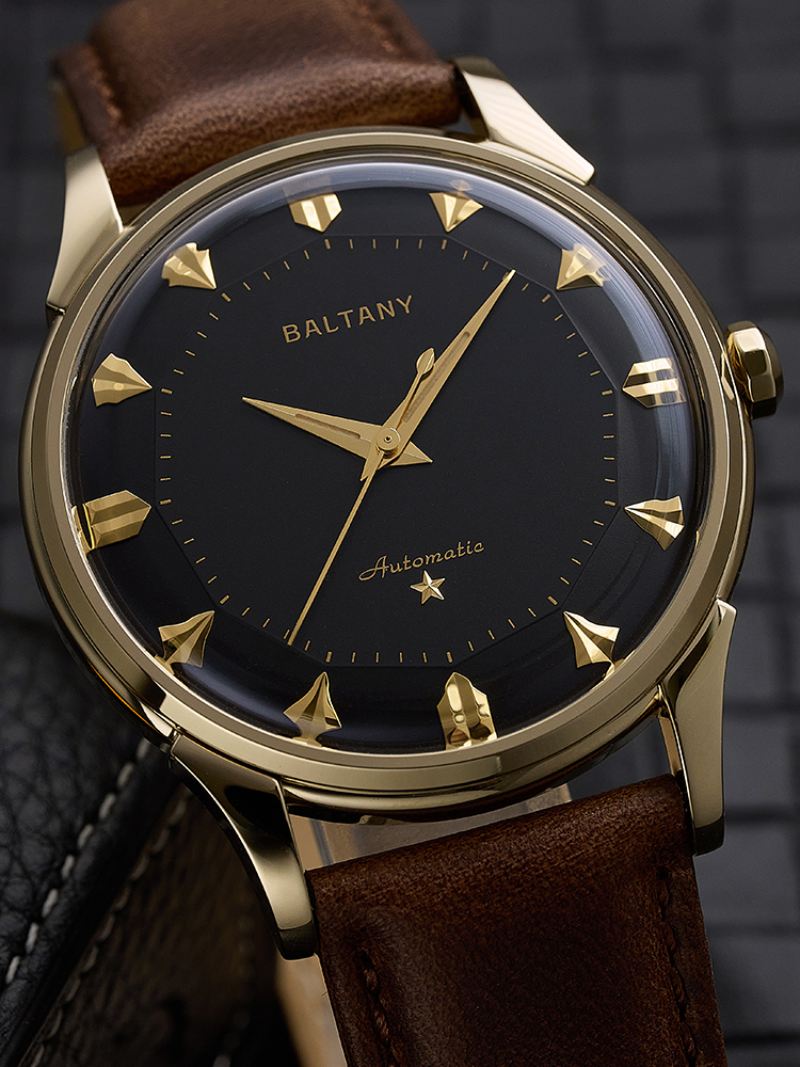
The Resolute Return to 36mm
This is exactly why we made a very definitive decision for the S4106: returning the case size to 36mm. Ultimately, the watch's physical dimensions were set with absolute precision:
- Case Diameter: 36mm
- Overall Width (including crown): 38.1mm
- Lug-to-Lug Length: 44mm
- Total Thickness (including domed sapphire crystal): 9.7mm
To us, this isn't simply "making it smaller"; it is a recalibration based on the proportional logic of vintage dress watches. The significance of 36mm lies not just in its classic status, but in how it strikes a highly natural balance between visual aesthetics and wearability:
- Visual Balance: It is slightly larger than many early original vintage pieces, better adapting to the wrist sizes and visual habits of modern wearers, while completely preserving the restraint, refinement, and understatement of mid-20th-century dress watches.
- Ergonomic Fit: The 44mm lug-to-lug span allows the S4106 to naturally contour to the wrist, making it especially suited for slender to medium wrists without the issue of overhanging lugs or disproportionate balance.
- Sartorial Elegance: The 9.7mm thickness grants this watch its ideal dress properties—slim, snug, and sharp, sliding effortlessly under a shirt cuff to maintain the effortless grace expected of a vintage dress watch.
For Baltany, the return to this size for the S4106 is not a conservative choice, but a conscious and deliberate insistence. Through this repeated scrutiny of millimeter-level proportions, we aim to resurrect the truly moving aspects of classic design. We believe that an outstanding vintage-style watch should do more than just "look like the past"—it should genuinely approach the most captivating state of that era in its size, thickness, wearing comfort, and overall proportions.
The Reinterpretation of Dial Optics and Colorimetry: How We View the Visual Tension of the S4106
During the development of the S4106, we were not satisfied with merely creating a watch that was "vintage in form." For us, what truly determines whether a timepiece has a soul—beyond its proportions and structure—is the emotional resonance of its colors, the optical depth of its dial, and the overarching atmosphere the wearer experiences at first glance.
Therefore, in designing the S4106's dial, we did not settle for the "safe answers" most common in traditional vintage watches—black, white, silver, and gold. Instead, while respecting the classics, we sought to create an expression that is more recognizable and carries greater modern aesthetic tension.
The Foundation of Classic Palettes
Naturally, we have retained classic color schemes that remain highly faithful to the traditional context. The S4106 offers fundamental choices of silver-white and black dials, which correspond to vintage expressions that are either more elegant and restrained, or more profound and steadfast, respectively. These colorways are an inherently mature part of the classic dress watch language, fulfilling the expectations of most wearers regarding traditional aesthetics.
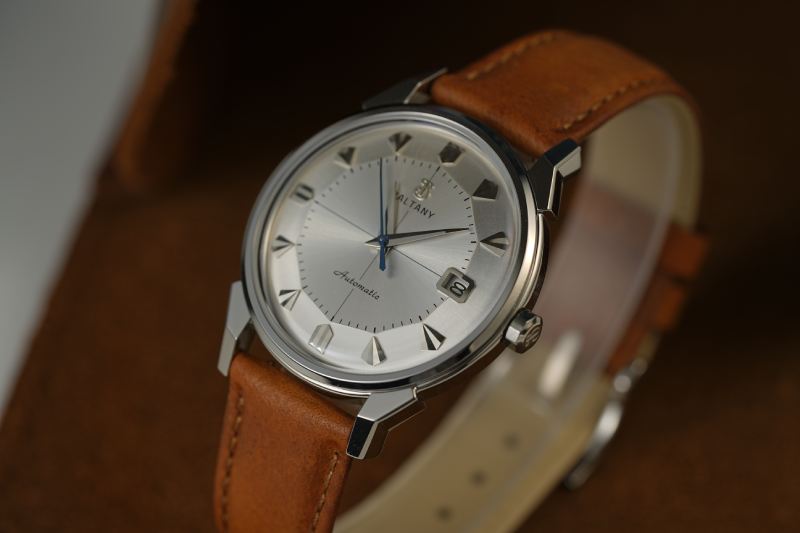
The Emotional Temperature of the Salmon Dial
However, for us, one of the most representative endeavors of the S4106 is the introduction of the salmon dial.
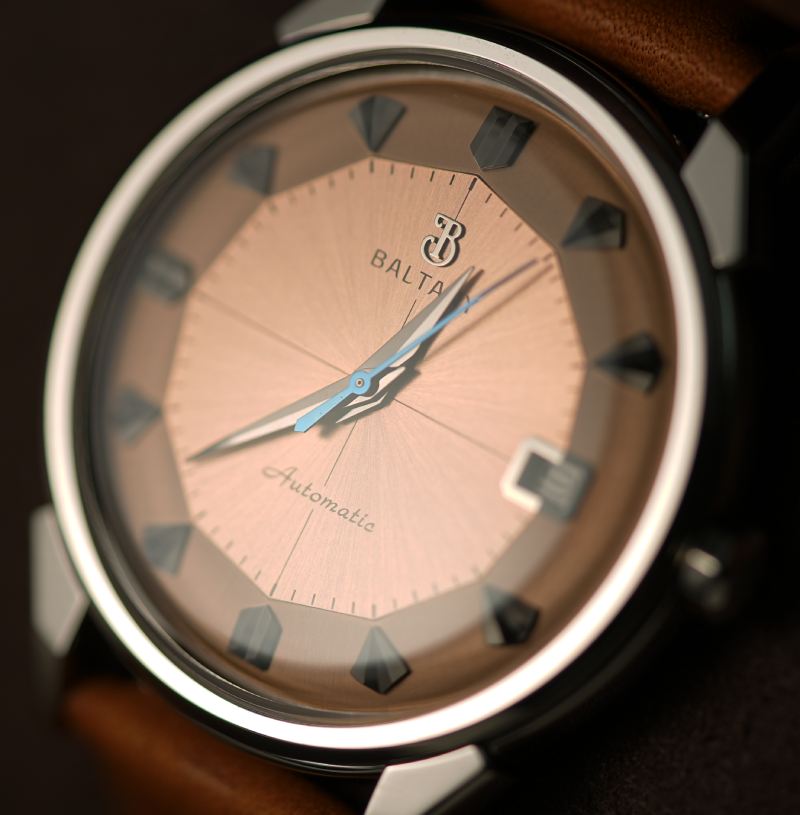
We have always believed that the allure of the salmon color lies not merely in its rarity, but in the highly unique emotional temperature it brings to the vintage watch context. It is not as cold as a pure silver dial, nor as overtly flamboyant as a gold one; rather, it strikes a delicate balance between warmth, softness, and a sense of passing time. This hue inherently carries strong historical associations and is naturally suited for vintage dial structures that emphasize depth, light and shadow, and intricate detailing. For this reason, we decided to officially introduce the salmon color into the Pie-Pan dial architecture of the S4106, allowing the watch to retain its classical silhouette while possessing a more distinct personality and richer visual expression.
The High-Contrast Engineering of "Gunmetal"
When selecting the material and color for the hour markers and hands, we again eschewed the conventional silver or gold options. To perfect the temperament of the salmon dial, we paired it with gunmetal applied markers and hands.
To us, this combination was not chosen simply to be "different"; it was a thoroughly considered balancing of color and optics. The salmon color is inherently warm, while gunmetal exudes a restrained, calm, and slightly industrial metallic aura. When these two temperaments share the same dial, they create a highly striking yet harmonious contrast of warm and cool tones.
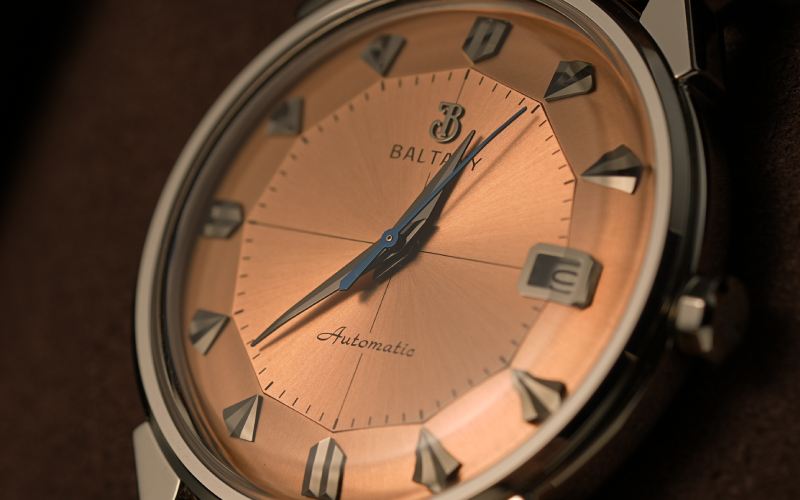
What this contrast delivers is not just visual individuality, but a more three-dimensional tension across the dial. The warm base color maintains the watch's vintage ambiance, while the austere gunmetal markers and hands inject a sharper, more modern edge into this vintage character. We are extremely fond of this dynamic: it is neither purely vintage nor deliberately modern. Instead, it discovers a balance between the two that perfectly aligns with Baltany's design language.
Performance in Real-World Wear
From the perspective of actual wear, this colorway also yields exceptional dial performance. Under varying lighting conditions, the salmon dial exhibits nuanced and rich tonal shifts, while the gunmetal applied markers maintain their crisp silhouettes amidst the light and shadow. This ensures the dial is both visually layered and highly legible.
When paired with a brown leather strap, the overall visual presentation conveys a complete, warm-toned vintage atmosphere; simultaneously, the inclusion of the gunmetal elements prevents the watch from falling into a monotonous mood of being overly soft or overly nostalgic.
Conclusion
For Baltany, the salmon dial of the S4106 is not merely an experiment in colorways; it is more akin to a fundamental reorganization of the classic dress watch dial language. Through the interplay of color, metallic texture, and three-dimensional structure, we hope this watch retains its historical breath while also claiming a distinct contemporary expression. This expression is not meant to be a gimmick, but a means to allow vintage design to genuinely continue growing and to radiate new vitality within today's aesthetic landscape.
Mastering the Details of the Pie-Pan Structure: How We Addressed the Geometric Dilemma of the S4106's Date Window
Throughout the entire dial development process for the S4106, the 3 o'clock date window was consistently one of the details we prioritized most, and it proved to be one of the most challenging. For many watches, a date window is merely a functional aperture; however, for a watch utilizing a Pie-Pan structure, the date window is not a problem that can be solved by simply "punching a hole." What it truly involves is a complex balancing act between the dial's three-dimensional geometry, the machining precision of micro-metallic components, and overall visual continuity.
The Geometric Conflict of the Pie-Pan Slope
The allure of the Pie-Pan dial stems from the clear and deeply layered transitional relationship between its flat central area and its peripheral sloping facets. It is precisely this downward-folding structure that endows it with a three-dimensional interplay of light and a classic temperament distinct from ordinary flat dials.
However, because of this very design, when a date function is introduced, the 3 o'clock window inevitably lands directly on the most sensitive intersection of this geometric relationship. If we were to simply rely on the flat date window frames commonly used in standard watches, the rigid, straight metallic borders would immediately conflict with the sloped plane of the Pie-Pan's edge. This would not only visually sever the originally fluid rhythm of the dial's fold lines but also render the entire date area abrupt and stark, ultimately destroying the unified three-dimensional harmony that the dial is meant to possess.
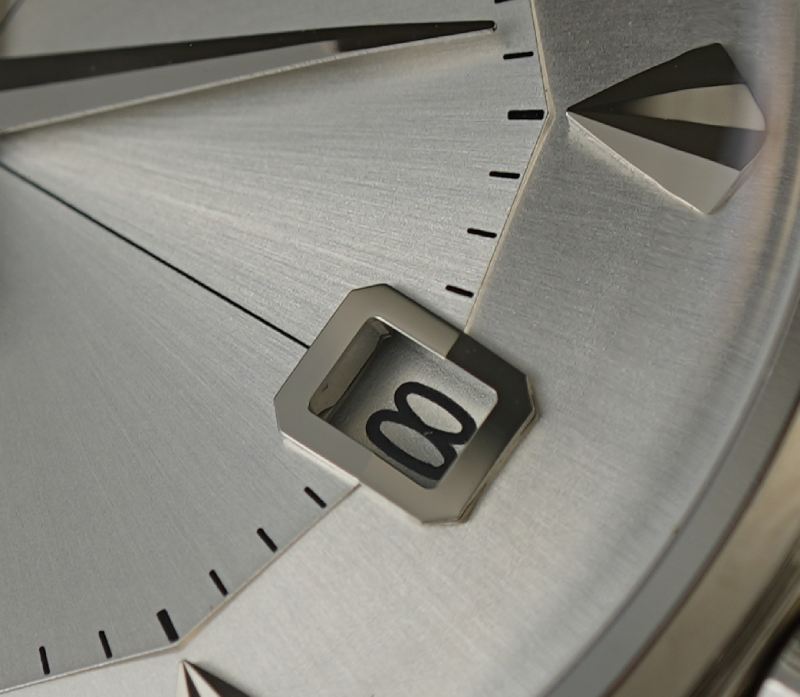
This was exactly the challenge we had to earnestly confront during the development of the S4106.
Engineering a Three-Dimensional Micro-Component
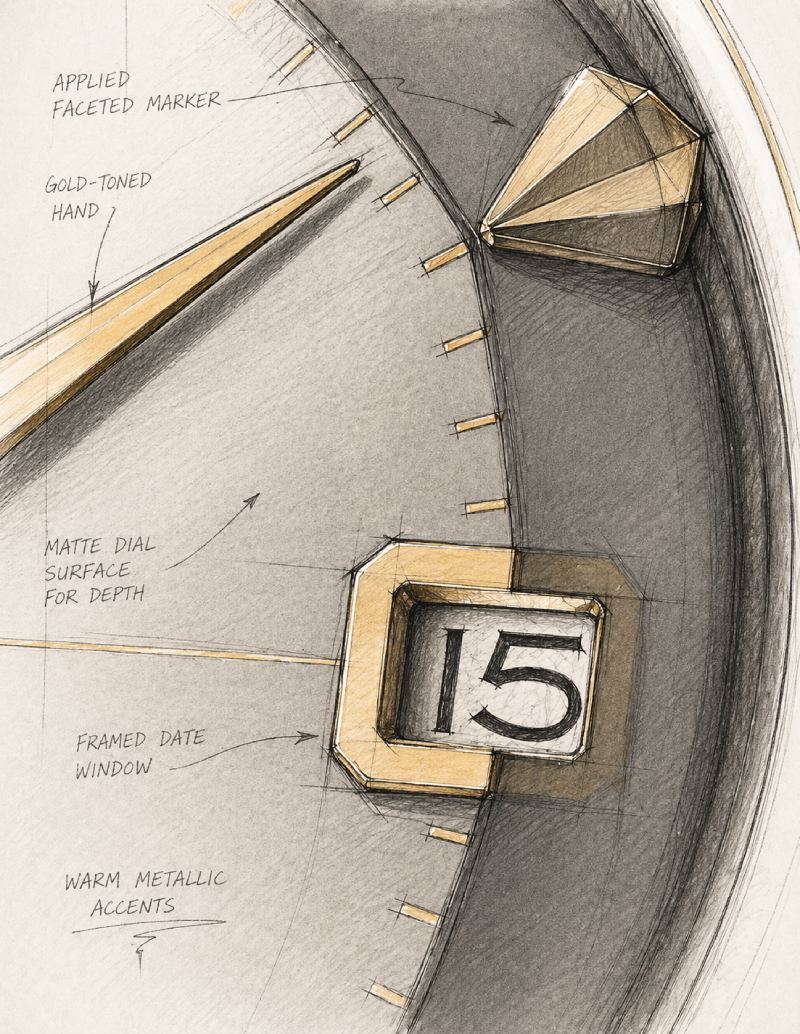
To ensure the date window genuinely integrated into the geometric structure of the Pie-Pan dial—rather than looking like it was forcefully stuck onto its surface—we abandoned the standard two-dimensional flat frame approach. Instead, we custom-designed a metallic date window frame featuring a deflected structure specifically for the S4106.
For us, the significance of this detail is not merely about making the watch "more refined." It is about ensuring the date window itself becomes an organic part of the dial's three-dimensional order. It is no longer a simple rectangular box; it is a three-dimensional micro-component that must simultaneously adapt to both the flat central plane and the cascading angle of the peripheral fold.
In practical terms, this meant the date window frame itself had to possess an angular shift that perfectly matched the fold line of the dial. During the design phase, we repeatedly refined its three-dimensional structure through meticulous geometric modeling, allowing it to naturally extend along the transition of the Pie-Pan dial rather than being trapped in a rigid, planar logic. The resulting effect is a date frame that hugs the dial's structure intimately and naturally, ensuring the entire date area is visually coherent and exudes the holistic refinement expected of a high-end timepiece.
The Machining Toll of Perfect Integration
Naturally, such a design meant the manufacturing difficulty escalated dramatically. Once the date window frame evolved from a simple flat piece into a micro-metallic component with a distinct deflection angle and a multi-faceted structure, the precision requirements during its milling, finishing, polishing, and assembly skyrocketed.
For a component of such minuscule proportions, even the most microscopic deviation in tolerance will directly manifest in the final visual effect after assembly:
- Can it seamlessly articulate with the dial's fold line without any gaps?
- Can it maintain impeccably clean and sharp edges?
- Does it hold up perfectly under magnified inspection? These criteria rigorously tested the consistency between our initial engineering designs and our final manufacturing execution.
The True Meaning of Modern Vintage Watchmaking
For Baltany, this level of investment is unequivocally worth it. We have always believed that for a classic dial language like the Pie-Pan, what truly moves people is never just the "broad silhouette." It is found precisely in these easily overlooked micro-details that ultimately dictate the piece's level of completion.
The execution of the S4106's date window is a prime example of this philosophy. It may appear to be just a small fraction of the dial, but it actually bears the weight of the entire watch's integrity regarding geometric logic, visual coordination, and artisanal expression.
When a wearer observes the Baltany S4106 up close, we hope they can tangibly feel that this detail wasn't simply an afterthought "added on," but was earnestly woven into the foundational design architecture of the entire watch. This embodies our core understanding of modern vintage watchmaking: it is not merely about replicating a classic silhouette, but about truly getting it right in every critical detail.
Optical Correction and Spatial Harmony: How We Addressed the Hands and Domed Sapphire Crystal of the S4106
During the development of the S4106, we consistently aspired for this watch to not only resurrect the charm of classic dress watches in its appearance but also, within its finer structural relationships, to carry forward traditional watchmaking's rigorous understanding of optics, geometry, and the actual time-reading experience.
Precisely because of this, the hand system of the S4106 is not merely a decorative element; it shares an incredibly tight connection with the Pie-Pan dial, the domed sapphire crystal, and the overarching internal spatial layout of the entire watch.
The Geometric Power of Dauphine Hands
We selected classic Dauphine hands for the S4106 and applied a high-polish finish, allowing them to exhibit crisp and deeply layered reflective shifts under varying lighting conditions. The reason for choosing this specific hand profile goes beyond its high visual compatibility with the temperament of a vintage dress watch; it inherently possesses a strong geometric presence and an expressive interplay of light and shadow, seamlessly echoing the faceted structure of the Pie-Pan dial.
The Three-Dimensional Bending Process: Eliminating Parallax and Maximizing Space
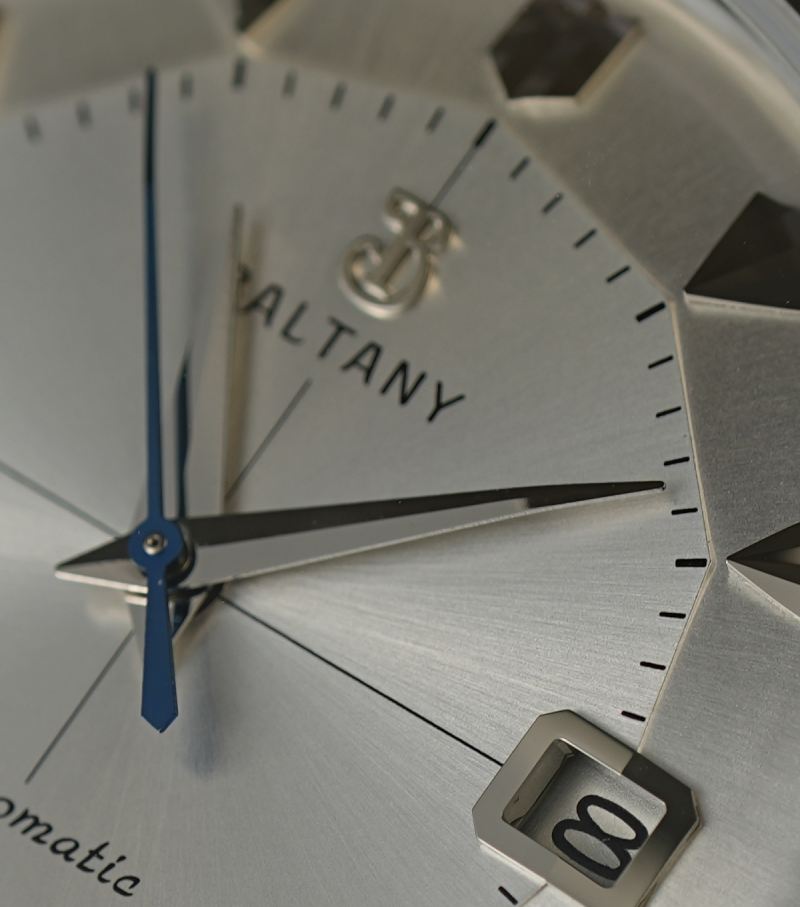
However, what truly validates this hand system is not just the shape itself, but how it is manipulated in three-dimensional space. To allow the hands to naturally hug the peripheral transition of the Pie-Pan dial, and to establish a more harmonious spatial relationship with the high-domed sapphire crystal, we applied a specialized physical bending process to the tips of both the minute and second hands. For us, this is not an expendable vintage flourish, but a critical component of the S4106's holistic architecture.
- Optical Precision (Anti-Parallax): This downward-curved tip design primarily delivers an enhanced time-reading experience. Because the S4106 utilizes a high-domed sapphire crystal—a structure with pronounced curvature—if the hand tips remained in their traditional straight form, the refraction at the edge of the crystal would create a slight visual misalignment between the hands and the indices when viewed from the side or at an angle. By bringing the tips closer to the chapter ring on the dial's periphery, we effectively minimize this parallax effect, ensuring time-telling remains natural and accurate from any viewing angle.
- Spatial Safety and Visual Harmony: Concurrently, this bending process serves the watch's spatial safety and visual harmony. The overall thickness of the S4106 is strictly controlled at a slender 9.7mm, meaning the internal space is inherently tight. While the high-domed crystal brings a stronger vintage ambiance, it dictates that the spatial relationship between the hands and the crystal must be managed with extreme precision. The trajectory of the curved tips conforms much closer to the ideal geometric relationship between the dial and the crystal dome, thereby avoiding any unnecessary risk of interference within this marginal space. Simultaneously, this subtle curve fosters a softer, more enveloping visual harmony between the hands and the crystal.
The Optical Performance of the Domed Sapphire Crystal
We equally value the optical performance of the crystal itself. The S4106 employs a high-domed sapphire crystal not merely to carry on the exterior silhouette of classic watches, but to ensure wearers can experience the rich, layered shifts between the Pie-Pan dial, the crosshairs, and the applied markers from any angle.
Compared to traditional acrylic materials, sapphire provides vastly superior scratch resistance. The addition of multi-layer anti-reflective (AR) coating on the inside further diminishes reflective interference, rendering the dial details highly transparent and clear. For us, this transparency is not simply about being "brighter"; it is about allowing the true light and shadow of the S4106's dial to be genuinely seen.
In AR coating applications, we have consistently been among the top brands on AliExpress.
The Soulful Accent: Heat-Blued Hands
In certain variations, we have further incorporated the detail of a heat-blued seconds hand. Particularly in the silver dial version, this blue seconds hand serves as a highly striking yet restrained visual accent against the overall cool-toned dial. It neither disrupts the watch's original classical order nor fails to add a layer of finer, warmer horological temperament. We have always favored this mode of expression; it does not deliberately command attention, but rather, in exactly the right place, it adds a touch of soul that truly belongs to a mechanical watch.
Conclusion
For Baltany, the hand system of the S4106 does not exist as an isolated component. It collaborates with the dial, the crystal, the case thickness, and the overall vintage atmosphere to form a complete design logic. Ultimately, we hope the message conveyed by these details is not simply "looks like a classic old watch," but rather a genuine modern vintage expression built fundamentally upon spatial relationships, time-reading experiences, and optical order.
Materials and Surface Treatment: Making the S4106 Not Just Beautiful, But Genuinely Suited for Daily Wear
For us, the development of the S4106 is not solely centered around vintage design. Beyond the dial, hands, and case silhouette—the elements that most easily catch the eye—we place equal importance on the actual condition of a watch during long-term wear. Particularly for fully polished dress watches, visual texture is undeniably important, but large expanses of mirror-finished surfaces are highly susceptible to hairline scratches in daily use. This is a common, real-world pain point encountered by many wearers.
Elevating Durability Without Compromising Aesthetics
Because of this, we wanted the S4106 to retain the refined aesthetics of a classic dress watch while significantly enhancing the durability of its exterior. To achieve this, the 316L stainless steel case of the S4106 incorporates a surface hardening treatment, granting it vastly improved resistance against minor friction and fine scratches during everyday wear.
The Limitation of Traditional 316L
316L stainless steel has long been a highly mature and ubiquitous material in the watchmaking industry. It boasts excellent corrosion resistance and stability, making it a foundational material we inherently trust. However, traditional 316L, when in a fully polished state, is indeed prone to showing minute signs of wear over prolonged use. For a timepiece that so heavily emphasizes the interplay of light and shadow alongside a mirror-like texture, these micro-abrasions can directly compromise the overall visual experience.
The Hardening Process
Therefore, we introduced a hardening process to the S4106, aiming to fortify the outermost layer of the case without altering the inherent physical properties of the 316L steel. Following this treatment, the surface hardness of the case is noticeably elevated. Compared to standard, untreated steel cases, it is far more wear-resistant in everyday contact environments, making it significantly easier to maintain the pristine, pristine condition of the polished surfaces over time.
Modern Practicality for Vintage Style
For us, the significance of this upgrade is not a blind pursuit of technical specifications. Instead, we want the S4106 to offer a practicality that aligns with modern wearing habits, seamlessly complementing its vintage style. It remains, at its core, a timepiece defined by its dressy temperament and classic proportions. Yet, through advanced materials and surface treatments, we ensure it can navigate daily use with absolute confidence, rather than being relegated to a fragile object requiring overly "careful admiration."
This perfectly encapsulates our understanding of modern vintage watchmaking: respecting the classic aesthetic, while utilizing today's more mature craftsmanship to resolve the practical, long-term wearability issues that plagued watches of the past.
Complex Lyre Lugs and the Interplay of Light and Shadow: How We Sculpted the Three-Dimensional Silhouette of the S4106
During the development of the S4106, we refused to compromise on the exterior finishing of the case simply because we incorporated a surface hardening treatment. On the contrary, we have always believed that since this watch emphasizes the three-dimensional silhouette and refined temperament of a vintage dress watch, the case's lines, facets, and polishing must flawlessly match the overarching design language.
Evolving from Dog-Leg to Lyre Lugs
The lugs of the S4106 are not a simple structure designed for manufacturing convenience. Building upon the foundational lug silhouettes of classic vintage dress watches, we further adjusted and optimized the micro-details. We wanted the case to retain its vintage flavor while possessing a more pronounced three-dimensionality and fluid transitional relationships.
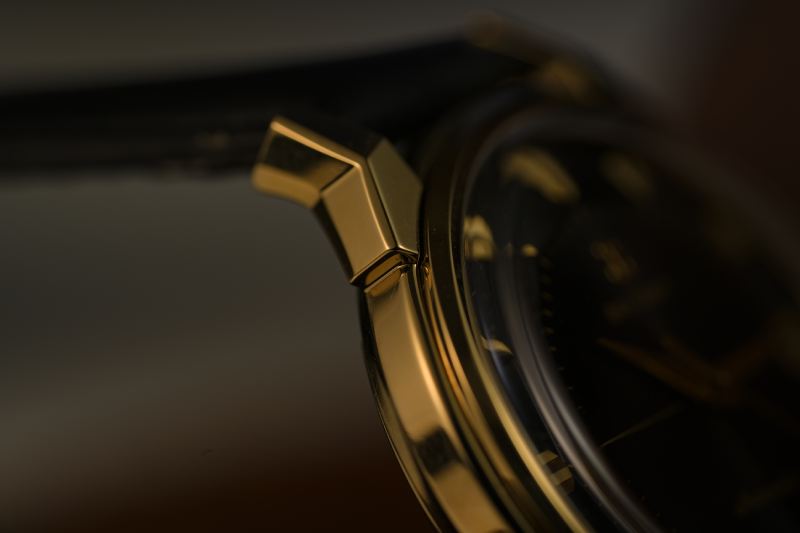
Compared to the more sharply angled and rigid expression of early "dog-leg" lugs, the S4106 emphasizes a geometric layering defined by "Lyre Lug" characteristics. This allows the lugs to exhibit a richer, more dynamic play of light from any viewing angle.
The Friction Between Hardness and Geometry
Naturally, this design brought about a significantly higher level of difficulty in machining and polishing:
- Complex Geometry: The S4106 lugs are not a single curved surface; they are composed of multiple facets, transitions, and varying inward and outward angles.
- Crucial Articulations: The articulation between every single facet dictates whether the final silhouette is sufficiently crisp and whether the watch's interplay of light and shadow is truly complete when worn on the wrist.
- The Hardening Challenge: Compounded by the case's surface hardening treatment, the elevated surface hardness turns the subsequent grinding and polishing processes into a severe test of craftsmanship control.
Preserving Sculptural Sharpness
For us, what truly matters is not just making the case "very shiny," but rigorously preserving the clarity of these edges and facets after polishing. If the boundaries are polished too softly and become blurred, the core three-dimensional spirit of the complex lugs is diluted, and the watch's intended sculptural feel diminishes alongside it.
Therefore, we insisted on a full high-polish finish for the S4106, aiming to maximize the light-and-shadow potential inherent to this geometric case shape, while diligently preserving the necessary sharpness and rhythm between the facets.
A Unified Visual Language from the Outside In
The final visual outcome is an aspect we value deeply. As the wrist turns slightly under various light sources, the multiple polished facets of the lugs and outer case continuously capture ambient light, creating richly layered reflections.
We intended for these shifting external reflections to seamlessly echo the faceted structure inside the Pie-Pan dial, ensuring the watch maintains a consistent three-dimensional language from the outside in. Because of this, as the eye travels from the case to the dial, the transition feels entirely natural and unbroken.
For Baltany, the complex lyre lugs of the S4106 were not designed simply to arbitrarily increase the difficulty of the project; they are a vital component of the watch's overall temperament. They carry not only the vintage silhouette itself but also our most earnest expression of case geometry, polished texture, and holistic aesthetic experience.
The Powertrain and Modern Practicality: A Crucial Component of the S4106's Complete Experience
For us, a watch truly suited for modern wear cannot rely solely on a vintage exterior. Appearance dictates the initial attraction, but what truly sustains the long-term wearing experience is always a stable, reliable movement system and sufficiently mature daily practicality.
The Miyota 9015: The Foundation of Ultra-Thin Elegance
Therefore, in selecting the movement, we did not adopt a more basic, thicker alternative to cut costs. Instead, we equipped the S4106 with the Miyota 9015 automatic mechanical movement from the Citizen Group.
A paramount reason for selecting this caliber is its inherent excellence in thickness control. The 9015 movement measures a mere 3.9mm in thickness, providing the crucial foundation for achieving the S4106's slim wearing profile. Precisely because of this ultra-thin core, the S4106—even when fitted with a high-domed sapphire crystal—still manages to restrain its total thickness to an impressive 9.7mm. This allows its visual presence and actual ergonomic fit on the wrist to closely approach our idealized state of a vintage dress watch.
Concurrently, the Miyota 9015 is a highly mature modern automatic caliber on a practical level. It operates at a frequency of 28,800 vibrations per hour (vph), equivalent to 4Hz. This higher beat rate setting not only delivers more stable chronometric performance but also visually translates to a smoother, more continuous sweeping motion of the seconds hand. For a timepiece like the S4106, this fluid yet restrained dynamic expression is intrinsically part of its overall elegant temperament. Furthermore, it offers approximately 42 hours of power reserve and features both hacking (stop-seconds) for precise time-setting and manual-winding capabilities—all of which are essential fundamental experiences for modern daily wear.
The Exhibition Case Back and Customized Rotor
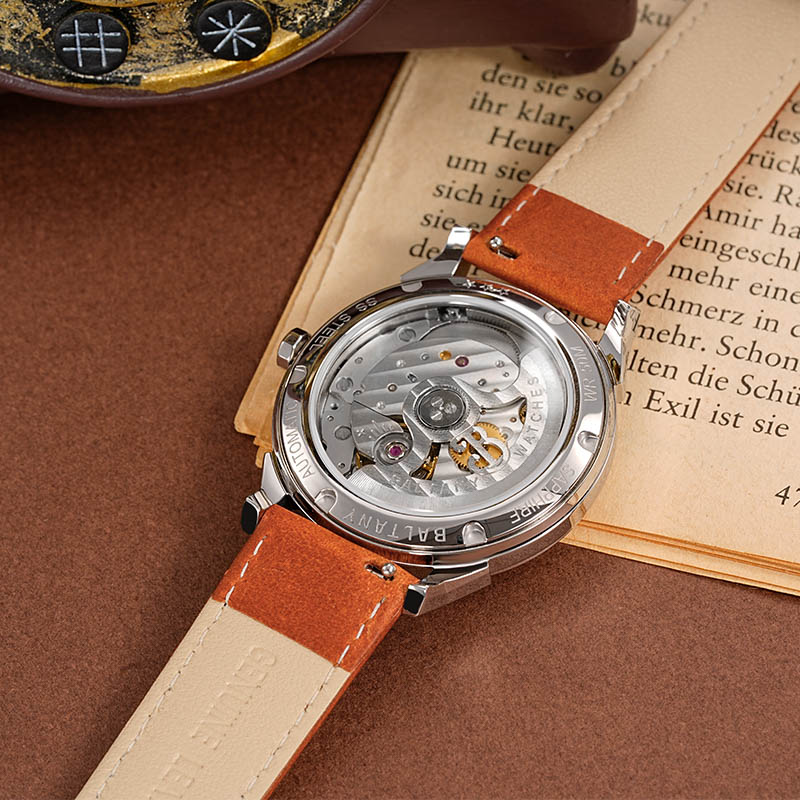
Regarding the case back design, we wanted the S4106 to transcend mere formal homage to historical classics. Although its design inspiration stems from the Constellation-style dress watches of the last century, we did not wholly copy the traditional closed case back. Instead, we opted to incorporate a screw-down exhibition case back.
The reasoning is straightforward: we understand that today's mechanical watch wearers care not only about the aesthetics of the dial but also about the mechanical intrigue derived from the movement's operation. Through the sapphire exhibition back, the wearer can directly observe the beating of the escapement, the operation of the gear train, and the inherent sense of vitality brought by the mechanical structure.
To complete this visual experience, we redesigned and customized the automatic winding rotor of the 9015 caliber. The rotor features the Baltany brand emblem and has undergone refined surface treatments to elevate its overall texture. To us, this is not merely an element of brand identification; it represents the structural completeness in detailing that the S4106, as a modern Baltany creation, ought to possess. It ensures that when this watch is turned over, it still conveys the expression and sincerity of a contemporary independent brand.
Built for Contemporary Life: Water Resistance and Usability
Beyond the powertrain itself, we equally value the S4106's adaptability to daily wearing environments. Many vintage-style watches are visually captivating but often create a sense of distance, making one feel they must be "worn with extreme caution." We do not want the S4106 to be such a watch.
To this end, it utilizes a screw-down case back paired with a sealed crown system, jointly constructing a comprehensive water-resistance architecture. The side of the crown is engraved with Baltany's signature three-dimensional "B" logo, maintaining unity between function and brand identity. Ultimately, the S4106 achieves a 50-meter water resistance. This means it is not a fragile vintage watch confined to indoor settings, but one fully capable of confidently handling splashes from hand-washing, daily humid environments, and sudden downpours.
We have also equipped the S4106 with a high-quality genuine leather strap featuring quick-release spring bars, aiming to further enhance its convenience in daily wear. Changing the strap no longer requires complex tools; the wearer can rapidly switch styles to suit different outfits and scenarios.
These seemingly minor modern upgrades actually serve a singular goal: to ensure the S4106 not only possesses the aesthetic soul of a vintage dress watch but also delivers a sufficiently flawless modern user experience. For Baltany, the S4106 is not a "vintage piece" meant only to be admired. We fervently hope it becomes a mechanical watch that can be genuinely worn and seamlessly integrated into contemporary life. It possesses classic proportions and historical temperament, yet it also boasts a modern movement, a modern water-resistance system, and modern wearing logic. Such a balance is precisely our understanding of the modernization of the vintage watch.
Conclusion: Beyond a Vintage Exterior—A Contemporary Recreation
For Baltany, "vintage" has never meant simply replicating the past. We firmly believe that a truly valuable vintage-style watch should not merely mimic the superficial silhouettes of historical classics, nor should it be confined to the mechanical cloning of a successful model. What is truly worth doing is to breathe new life into it, using contemporary watchmaking capabilities, material conditions, and wearing demands, all built upon a profound understanding of the original classic design spirit.
The S4106 was born precisely under this philosophy.
We have always held immense respect for the aesthetic order and technical standards established by mid-20th-century Swiss watchmaking. Masterpieces like the Omega Constellation Pie-Pan became classics not simply because they look "beautiful," but because they established a sophisticated language for haute horlogerie dress watches—spanning proportions, structure, dial depth, case silhouette, and overall temperament—that remains valid today. For us, the significance of creating the S4106 is not simply to return to the past, but to ponder: if these classic designs were born today, empowered by more mature machining processes, advanced materials technology, and a clearer understanding of modern wearing scenarios, how far could they be advanced?
Therefore, the S4106 is not merely a visually vintage watch. It is more akin to a systematic reconstruction of the classic dress watch from a modern horological perspective. We insisted on returning the size to the historically resonant and ergonomically balanced 36mm, not to pander to trends, but because we believe this proportion inherently aligns closer to the true essence of such designs. We adopted highly recognizable dial color combinations and applied index languages not as a gimmick, but to inject a visual tension unique to contemporary Baltany while preserving the classical framework.
We invested an equal amount of energy in the places users might not immediately see at first glance. Whether it is the detailed structural adjustments made to accommodate the spatial relationship between the Pie-Pan dial and the domed crystal, or the meticulous, iterative refinement of the date window's geometry, the shape of the hands, the facets of the case, and the assembly precision—these are not elements that can simply be "cranked out." They determine whether this watch ultimately holds true, whether it is sufficiently complete, and whether it retains its compelling power under close inspection.
This is exactly our understanding of modern vintage watchmaking: it is not about diluting the classics, but using today's technological conditions to protect them, fortify them, and enable them to genuinely adapt to today's lifestyle.
Thus, for us, the Baltany S4106 is more than a visual response to a historical masterpiece. It is an entirely new creation built upon modern materials science, precision machining capabilities, and contemporary wearing logic. It preserves the most captivating proportions, light play, and temperament of classic dress watches, while simultaneously evolving into a mechanical watch truly capable of serving modern usage scenarios through a more reliable movement system, a mature water-resistance structure, durable case treatments, and a complete wearing experience.
We hope that what the S4106 brings to the wearer is not merely a "look of the past," but a genuine realization: that the classic designs established over half a century ago can still possess new precision, new longevity, and a new mode of expression today.
This is what Baltany has always strived to do—not to linger on the surface of vintage, but, grounded in a deep respect for history, to earnestly craft the classics of this era.
Order the Baltany S4106 now and be among the first to experience the essence of vintage refinement:Baltany S4106