Shopping cart is empty.
Total (USD):$10.00
Checkout
 $ USD

The Face That Stayed:Baltany S4112 - 36mm Baton-Dial Day-Date Homage
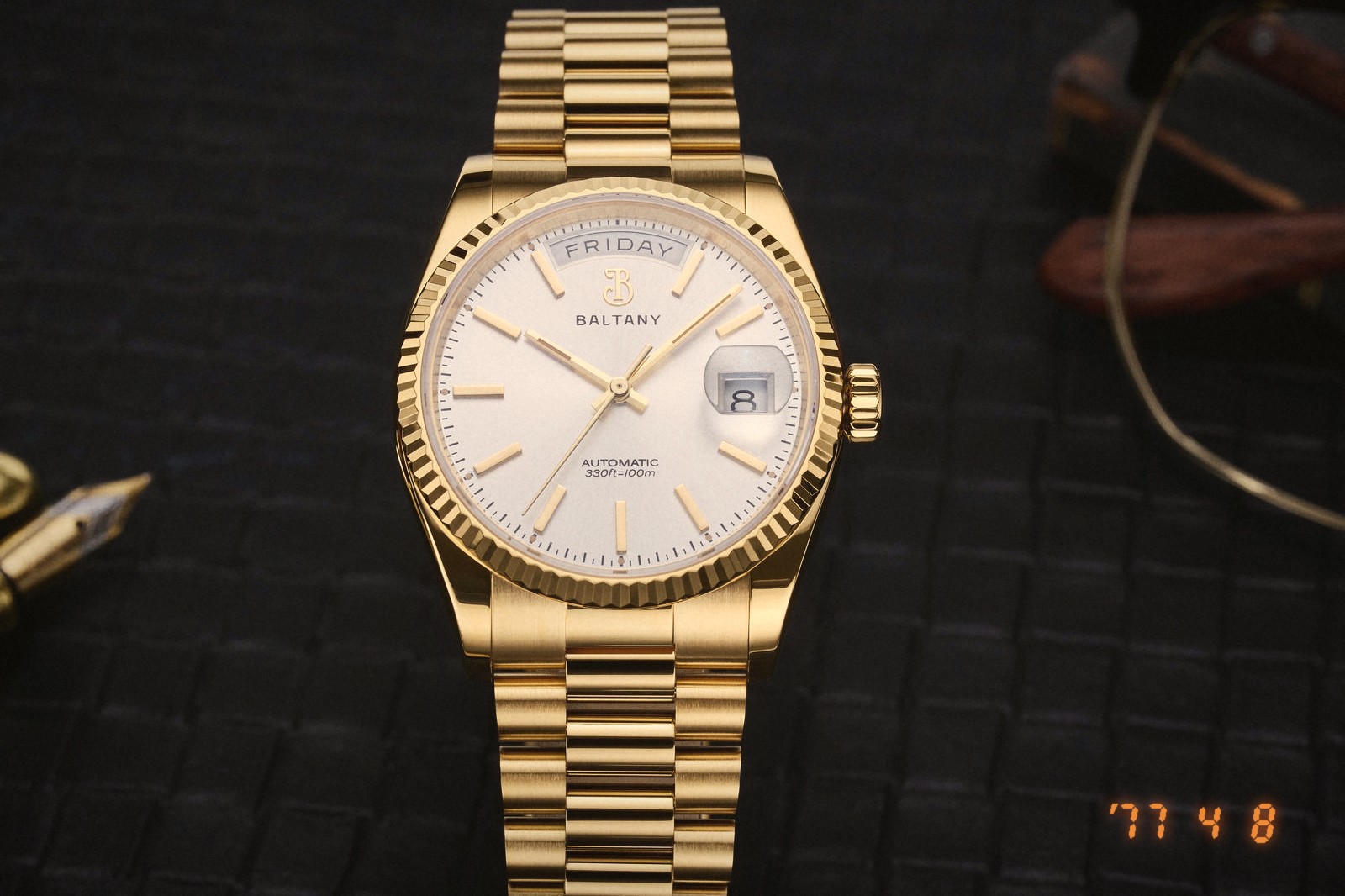
A Friday, the 8th. The camera’s date stamp and the watch agree.
Tuesday, 7:40 a.m.
Nobody needs a watch to know it’s their birthday. You need one on a Tuesday: the coffee is too hot, the train is three minutes late, and for one blank second you honestly couldn’t say what day it is.
That second is what the Day-Date was made for. Since 1956, the window at twelve o’clock has spelled the day out in full, so you never have to count back from the weekend. The S4112 keeps that window and pairs it with the face most people picture when they hear the name: polished baton markers on a sunburst dial.
1956
The Day-Date made its debut at the Basel fair in the spring of 1956. The first references were the 6510, with a smooth bezel, and the 6511, with a fluted one. Both ran on the Cal. 1055, and Rolex presented the new model as the first calendar wristwatch to spell out the day of the week in full, alongside the date.
It was not a modest watch. Rolex only ever offered it in 18k gold or platinum, and it arrived on a new bracelet of semi-circular, three-piece links in the same precious metals. The bracelet was called the President.
Still, the 1956 watch did not look quite like the one in your head. Its dial was a “pie-pan”: flat in the middle, with an outer ring that slopes away toward the edge, like a dish turned upside down. The lume was radium, and the first dials came in white, black and champagne.
The hands were faceted Dauphine or Alpha shapes, depending on which archive you trust. Sharp little blades, not straight sticks.
Handsome, certainly. Plain, not yet.
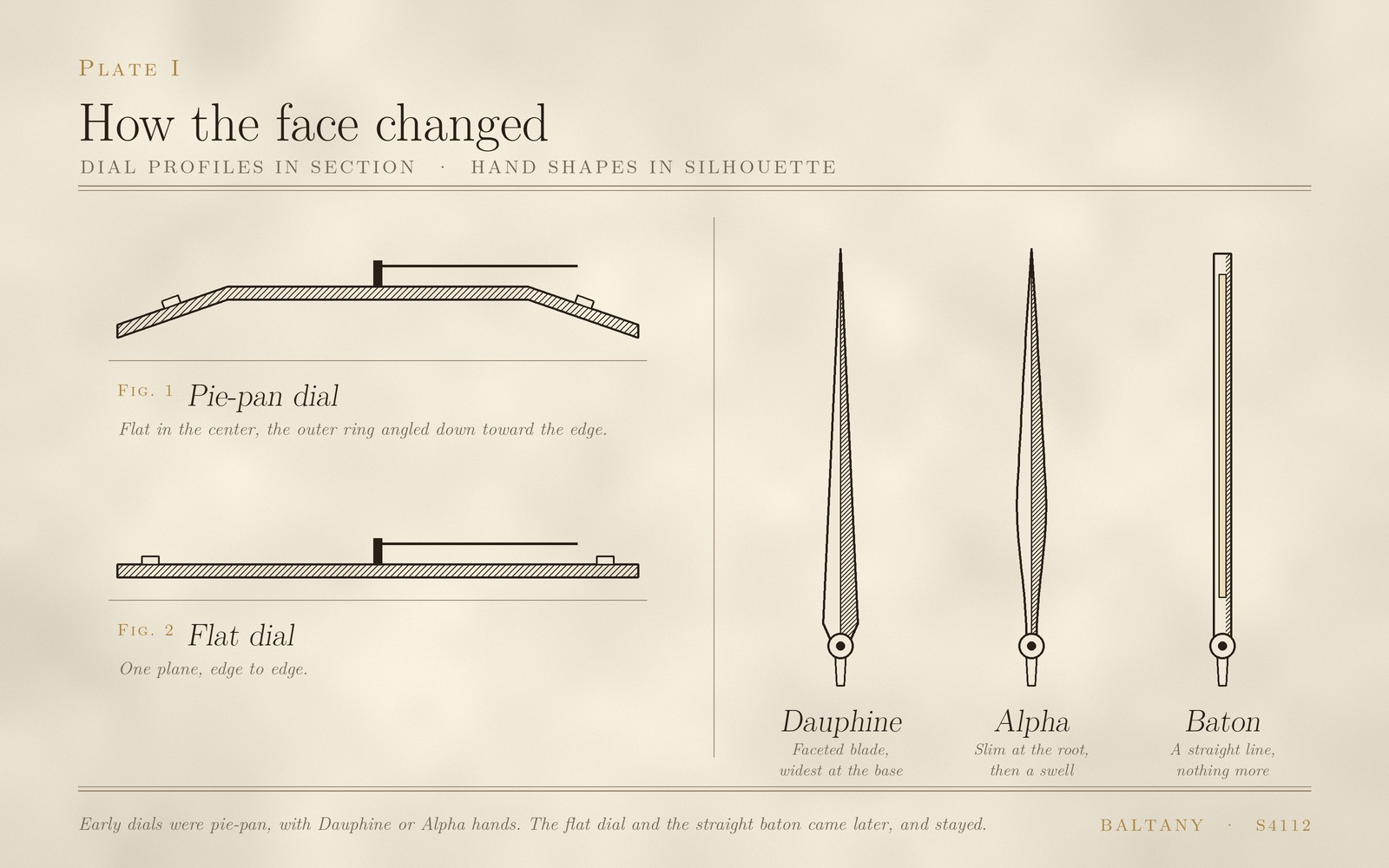
Plate I. The pie-pan dial and faceted hands of the early years, beside the flat dial and straight baton that came after.
1959–1988
The watch that fixed the picture was the Ref. 1803. It stayed in the catalog for nearly two decades, from the turn of the 1960s to the late 1970s; sources disagree by a year at either end. Inside was a slimmer movement, the Cal. 1555 and later the 1556. On top sat an acrylic crystal, and many examples still wore pie-pan dials.
Over those years the menu grew. The 1960s brought greys, blues, mother-of-pearl and textured dials. Meanwhile the straight baton, a hand and a marker with nothing to explain, slowly became the mainstream look.
The bezel changed jobs, too. Rolex’s fluting began as a tool: the ridges let the bezel be screwed down onto the case, helping keep water out. Over time the tool became a signature. On the S4112, as on most watches that wear it now, the fluting is there for the light.
In the late 1970s the Ref. 18038 took over. It added a sapphire crystal and a quick-set date, and it stayed in production until 1988. By then the formula had set like plaster: fluted bezel, baton markers, President bracelet, the day arched across the top of the dial.
Ask someone to draw a Day-Date and that is what they draw.
Why the Batons Won
A baton is a line pointing at the center of the dial. That is the whole idea, and it is a good one.
There is nothing to decode. No numerals, no ornament standing between you and the time. In a dim restaurant or on a gray train platform, your eye reads the angle of a hand against a ring of short bars and knows the time before it has finished looking.
The S4112 uses raised baton markers, faceted and polished, so their edges flash as the wrist turns. In our community, the raised-baton version has been the most popular configuration of all. On the steel S4112 the markers are silver. On the gold-tone S4112G they are gold, so dial and case read as one color family.
The hands follow the same logic: faceted, polished and filled with Swiss Super-LumiNova® in a vintage tone, so they stay findable after the lights go off.
2026
The original never came in steel. The S4112 is made in 316L steel, left natural or finished in gold-tone IP, and that quietly changes its job: from the watch you save for dinner to the one you wear to work.
The steel S4112 comes in black, a bright blue and silver, each with silver markers on a sunburst finish that brightens and darkens as light moves across it. The gold-tone S4112G comes in black, green, silver and gold, with gold markers, and carries one warm tone across the case, bezel, crown, caseback, bracelet and clasp.
Black and silver are the quiet ones. The blue and the green are for people who like a little color on a Tuesday.
Seven dials, for a seven-day week. Make of that what you will.
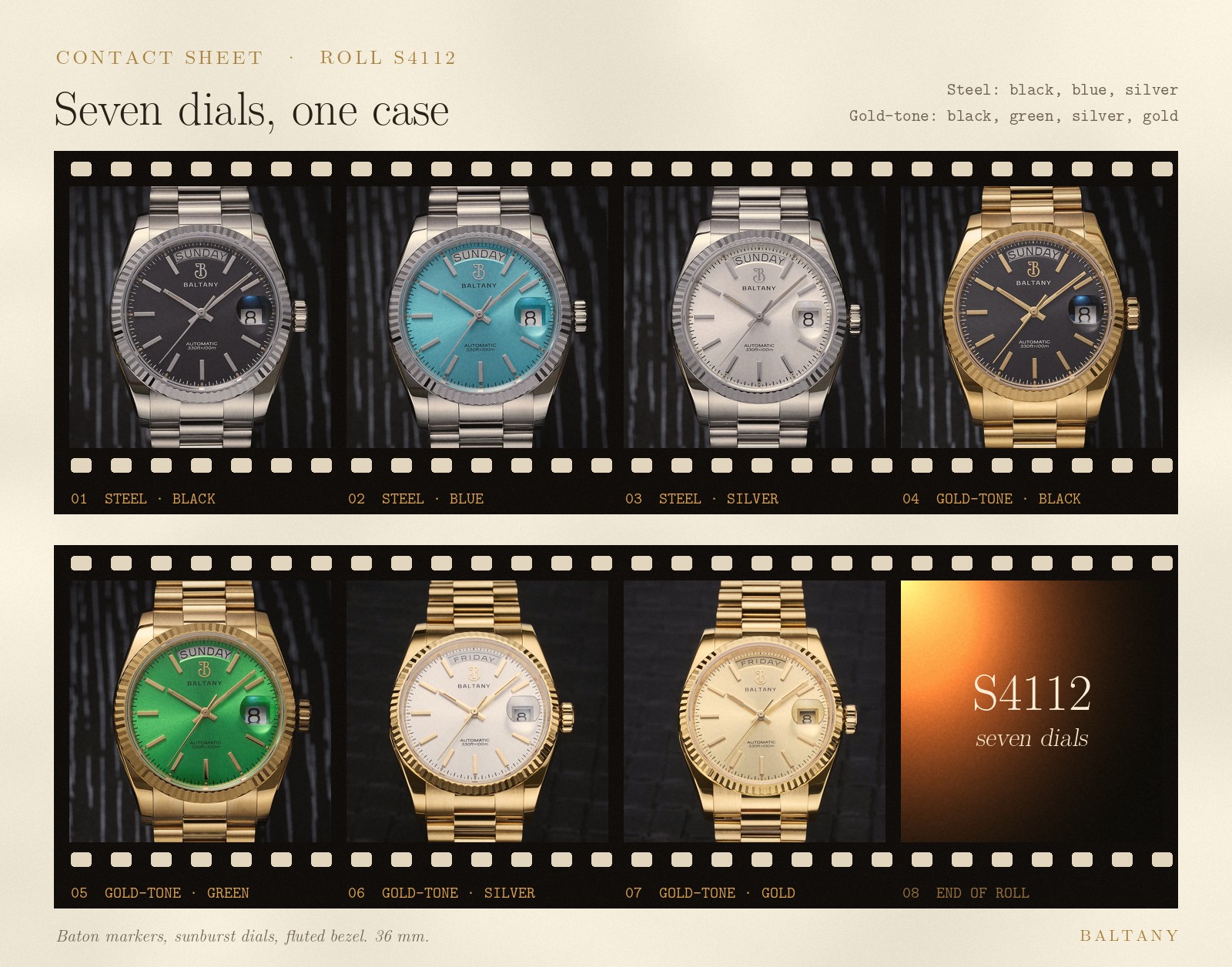
Roll S4112: three steel dials, four gold-tone, and the end of the roll.
Nothing to Be Careful About
An everyday watch has to survive an ordinary week. The S4112 is built for one.
The case is polished 316L stainless steel, 36 mm across and 43.5 mm from lug to lug, so it sits inside the wrist instead of hanging over it. It stands 11.25 mm tall including the crystal and weighs about 110 g on its bracelet, enough that you know it’s there. The crown screws down and carries an etched “B”. The caseback screws in. Water resistance is 100 meters.
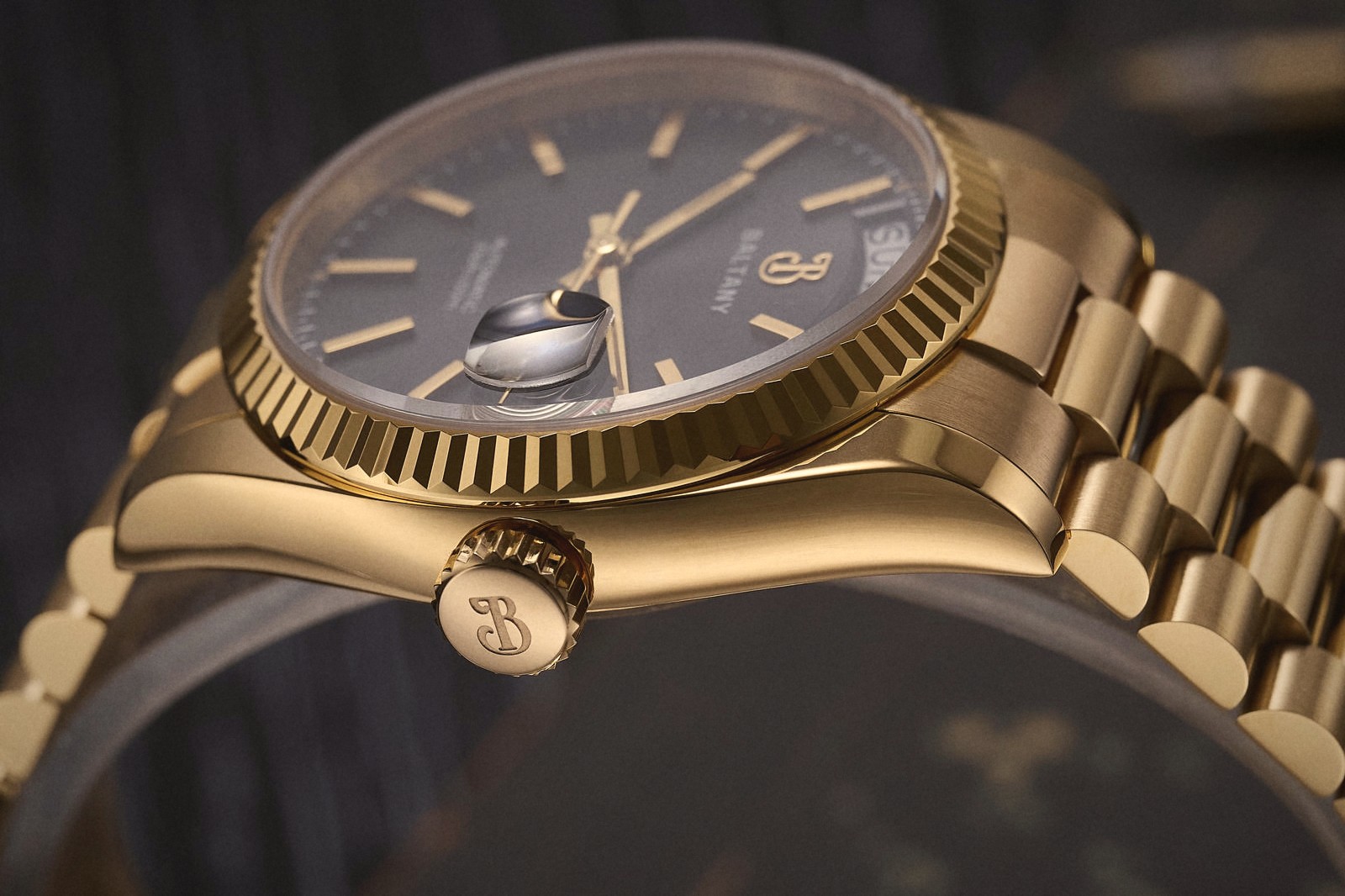
The screw-down crown with its etched “B”, tucked under the fluted bezel.
Over the dial sits a sapphire crystal with an anti-reflective coating, plus a Cyclops lens that enlarges the date at three. Rain, a sleeve cuff, a desk edge: none of it needs a second thought.
Inside runs the Hangzhou 6330 automatic, with 28 jewels, 28,800 vibrations per hour and about 38 hours of power reserve. Take it off on a Saturday night and it should still be running when you pick it up on Sunday.
The three-link President-style bracelet closes on a concealed “B” deployant clasp, so the links run around the wrist without a visible break. Between the lugs it measures 20 mm.
Two Pages of One Catalog
The S4112 has a sibling, the S4109. They share the same case, the same bracelet and the same movement: two configurations of one prototype, or two facing pages of the same old catalog.
The S4109 is the jewelry page, with stone-set hour markers, mother-of-pearl and enamel, made for occasions and gifts. The S4112 is the everyday page, with plain batons on sunburst dials, made for Tuesdays. We planned the two color ranges side by side, so each answers a different mood.
| S4112 | S4109 | |
|---|---|---|
| Hour markers | Raised, faceted, polished batons | Stone-set CZ, rectangular stones at 6 and 9 |
| Dials | Sunburst: black, blue, silver (steel); black, green, silver, gold (gold-tone) | White mother-of-pearl, yellow enamel, gradient burgundy sunburst, gold sunburst; mother-of-pearl with red or blue CZ (gold-tone) |
| Case | Steel or gold-tone IP | Steel or gold-tone IP |
| Wear it | Every day | When the day deserves it |
| Weight | Approx. 110 g | Approx. 112 g |
The Sheet
| Spec | S4112 (steel) / S4112G (gold-tone) |
|---|---|
| Movement | Hangzhou 6330 automatic, 28 jewels, 28,800 vph, approx. 38 h power reserve |
| Case | 316L stainless steel, polished; steel, or gold-tone IP with matching bezel, crown, caseback, bracelet and clasp |
| Bezel | Fixed, fluted |
| Diameter | 36 mm (38.9 mm with crown) |
| Lug to lug | 43.5 mm |
| Thickness | 11.25 mm including crystal |
| Lug width | 20 mm |
| Dial | Sunburst with raised baton markers. S4112: black, blue or silver, silver markers. S4112G: black, green, silver or gold, gold markers |
| Hands | Faceted and polished, with Swiss Super-LumiNova® in a vintage tone |
| Crystal | Sapphire with anti-reflective coating, Cyclops lens over the date |
| Crown | Screw-in, 316L, etched “B” |
| Caseback | Screw-in, 316L |
| Bracelet | Three-link President-style, stainless steel |
| Clasp | 316L “B” concealed deployant |
| Water resistance | 100 m (330 ft) |
| Weight | Approx. 110 g |
Next week the window will say MONDAY, then TUESDAY, then the rest, in plain capitals at twelve o’clock. That is the job. The S4112 turns up for it every day.
Pick Your Week
Seven dials, two metals, one case. Choose the one you’ll reach for on Monday morning.
-
Shop the S4112 in steel: black, blue, silver →
-
Shop the S4112G in gold-tone: black, green, silver, gold →
Saving it for a special day instead? Its sibling, the stone-set S4109, was made for exactly that.