Shopping cart is empty.
Total (USD):$10.00
Checkout
 $ USD
$ USD
Details You Can't See on a Spec Sheet: Inside Baltany's Craft
Every watch brand publishes the same numbers. 316L stainless steel. Sapphire crystal. Swiss lume. 100m water resistance. Read enough spec sheets and they start to blur together — which is exactly the problem. The spec sheet tells you what a watch is made of. It tells you almost nothing about how well it was made.
At Baltany, we've always believed the opposite is true: the material is the starting point, the execution is the watch. Two cases cut from the same bar of 316L can feel like they came from different decades, depending on who finished them and how much time they were given.
This article is about that gap. It's a walk through the manufacturing decisions we make that don't fit neatly into a product listing — the hardening, the transitions, the tolerances, the movement choices — and why we keep making them even when they cost us margin.
1. Hardened Cases: Making 316L Behave Like Something Better
316L stainless steel is a good-quality material in its own right. Nowadays, most watches are equipped with 316L stainless steel cases.
Since dress watches focus heavily on overall refinement and visual quality, even minor imperfections can affect the appearance. Therefore, we are gradually introducing hardened case technology into our dress watch collection to help reduce scratches and maintain the watch’s pristine finish.
So we invested in surface hardening — a controlled thermal-chemical treatment that transforms the outermost layer of the steel's crystal structure, dramatically raising its resistance to scratching while leaving the core of the case tough and non-brittle.
Crucially, this is not a coating. There is no plating layer to chip, wear through, or discolour at the edges. The hardness is in the steel.
| Model | Surface Hardness | |
|---|---|---|
| S4090 Pie Pan | ~500 HV | |
| S4092 Crosshair Small Seconds | Hardened | |
| S4106 (Constellation-style) | Hardened | |
| S6047 A-7 Pilot | ~500 HV | |
| S6048 / S6048 Mono-pusher | ~600 HV | |
| S6083 GMT Sports | ~500 HV | |
| S101 | Hardened |
That's two and a half to three times the surface hardness of a standard steel case.
Getting here was not straightforward. The difficulty with hardening a finished watch case is that the process runs hot, and heat is the enemy of everything you've already achieved: polished surfaces haze, brushed grain shifts tone, and — worst of all — the case can distort by a few microns, which is enough to ruin the fit between case, bezel, caseback and crystal gasket.
2. A Crystal You Forget Is There
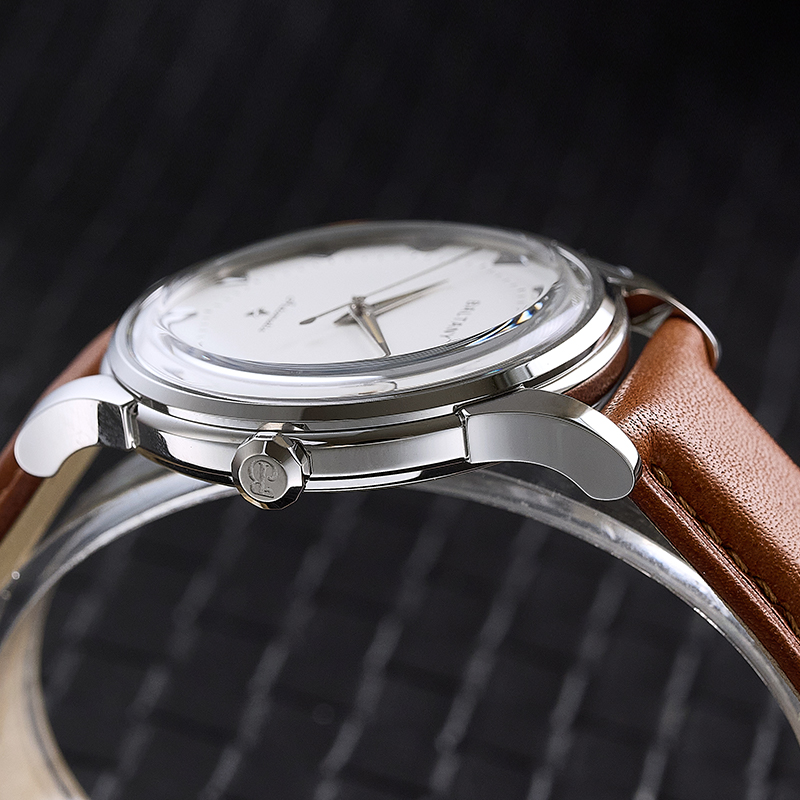
The goal of a good sapphire crystal is to disappear. Not to look clear — to stop registering as a surface at all, so your eye lands on the dial with nothing in between.
Two things stand between you and that experience: reflection and colour cast. Cheap anti-reflective treatment kills some glare but throws a heavy blue or purple wash over the dial, which is particularly destructive on a vintage watch where the whole point is a warm, aged colour palette.
Our sapphires use a multi-layer AR treatment tuned for neutrality first, then transmission — we'd rather give up a fraction of a percent of light than tint the dial.
3. The Line Between Polish and Brush
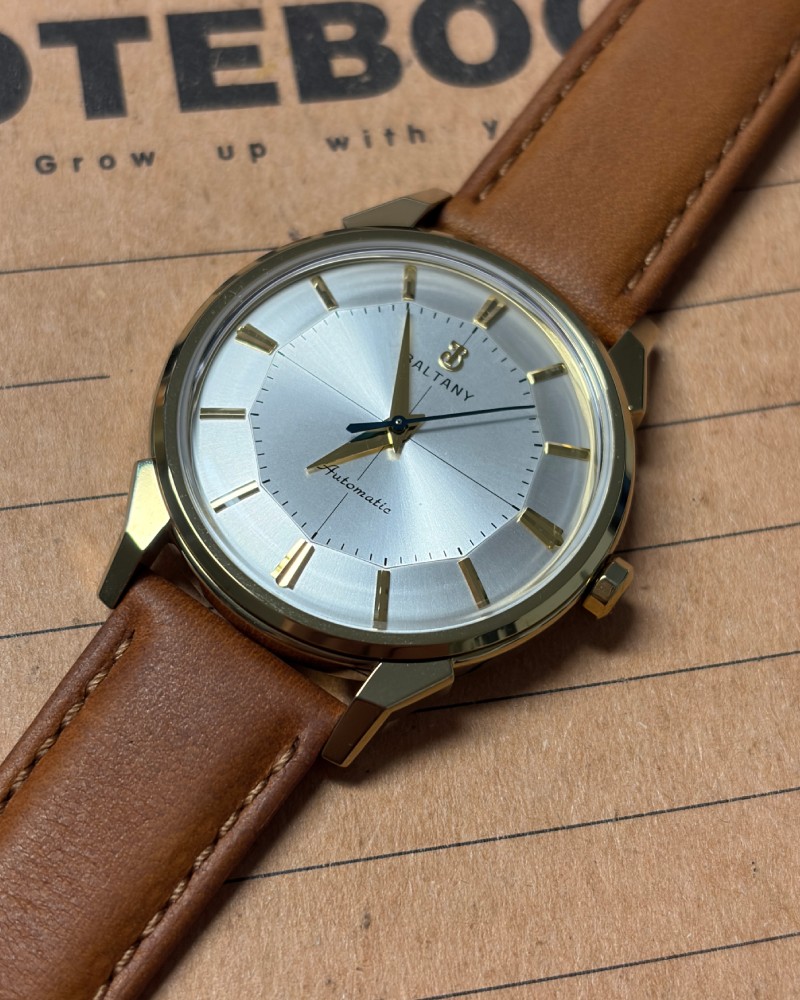
If you want to judge a watch case in five seconds, don't look at the polished surfaces. Look at where two different finishes meet.
A case is an assembly of facets. On most of our designs, brushed surfaces sit directly against polished ones — the classic vintage-formal contrast that gives a case its sense of structure.
- Polishing a facet drags compound and rounded gloss over the adjacent brushed area, muddying the grain.
- Brushing a facet throws abrasive lines across the neighbouring polished area, dulling the shine.
Our answer is hand work. Transition zones on our cases go through a dedicated manual edging step, performed by a finisher working under magnification, isolating each surface so the neighbouring one stays untouched.
4. Bracelets: Where Tolerance Is the Whole Game
A bracelet is the part of a watch you're in physical contact with all day, and it's where corner-cutting is felt rather than seen.
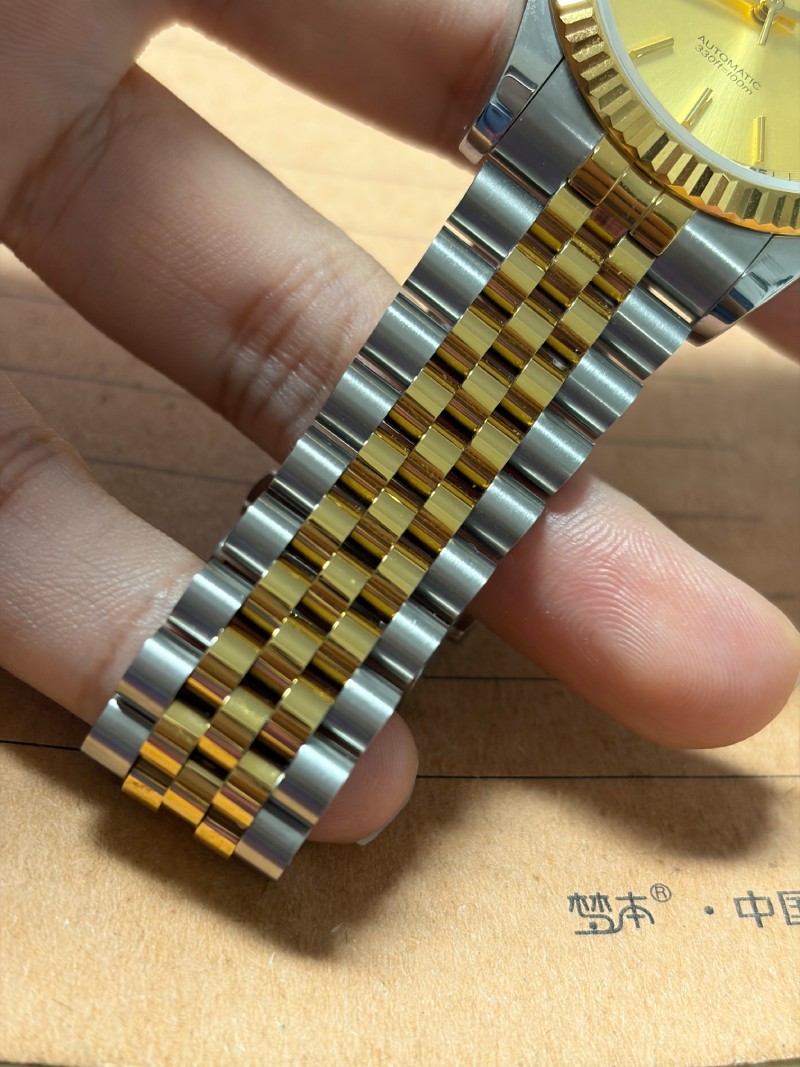
Beads-of-rice bracelets
These are genuinely difficult to build well. A five-link bracelet has several times the number of components and articulation points of a simple three-link, which means several times as many opportunities for accumulated error.
Get it wrong and you have a bracelet that rattles, kinks, or sags. Our beads-of-rice bracelets are first-rate: the centre beads are uniform, the drape is fluid across the full length, and the taper flows into the case without a step.
Brushed bracelets
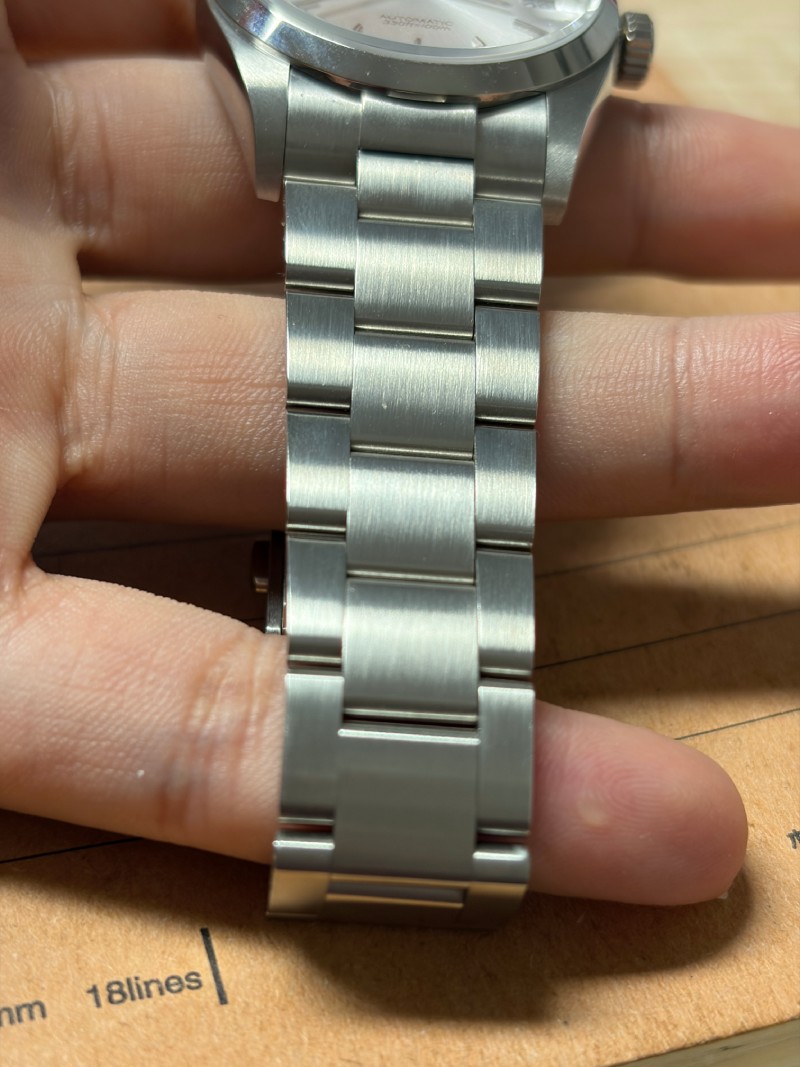
The test here is consistency. Brushing individual links is easy; brushing hundreds of links so that the grain direction, depth and tone match across every single one — and match the case they attach to — is a process-control problem.
We hold grain consistency link-to-link tightly enough that the bracelet reads as one continuous surface rather than a chain of separately finished parts.
Tolerance control
And the part nobody talks about: tolerance control. We hold tight tolerances on link and pin fitment, which delivers two things you notice immediately:
- No light gaps. Hold the bracelet up against a light source and you shouldn't see daylight through the joints. Sloppy clearances show up as visible gaps and, over time, as lateral play and rattle.
- No pinching. Excess clearance between links is what lets a bracelet grab skin and arm hair as it flexes. Every wearer knows the feeling. It is entirely a tolerance problem, and it is entirely preventable.
5. Lume: Grade A Swiss, Fully Filled
We specify Grade A Swiss luminescent material across the range. That's the easy half of the sentence.
The half that actually determines performance is application. Lume is hand-applied into hand and index recesses, and the amount that goes in determines both brightness and how long the glow holds.
Under-filling is the most common shortcut in the industry because it's fast, it saves material, and it's invisible in daylight.
A partially filled index looks completely normal at noon and dies within an hour of sunset.
We fill completely — recesses loaded to full depth, with a consistent, level surface across every marker so the dial glows evenly rather than as a constellation of bright and dim points.
Under magnification you can see the difference: full, domed fills with clean edges and no shrinkage voids.
6. Movements: Regulated Properly, and Absolutely No Phantom Date
Five-position regulation, on every single watch
A mechanical movement doesn't keep one rate — it keeps a different rate depending on how gravity is acting on the balance.
Regulating in a single position gets a watch through a quality gate; it does not get you a watch that performs on a wrist.
Every mechanical Baltany is regulated in five positions before it leaves the factory, and every movement goes through individual bench adjustment rather than batch spot-checking.
We guarantee that our watches perform within the stated accuracy specification of the calibre inside them.
It adds meaningful time per unit at final assembly. We consider it non-negotiable — an unregulated movement is the fastest way to turn a beautifully finished watch into a disappointing one.
The phantom date: a detail we refuse to ship
Here's one that almost no brand will discuss, because almost every brand does it.
Take the Seiko NH35 and NH38. Mechanically they're siblings; the difference is that the NH35 carries a date mechanism and the NH38 doesn't. The NH38 costs slightly more.
So when a brand builds a no-date watch, there's a tempting shortcut: drop in the cheaper NH35, hide the date wheel behind the dial, and ship it.
The result is a phantom date — a crown position that does nothing.
You pull the crown out one click and turn it, and somewhere behind the dial a date wheel you will never see rotates uselessly.
The watch has a setting position for a function it doesn't have.
Most owners shrug at this. One extra click, who cares. We see it differently: you're going to wear this watch for years. You'll set the time hundreds of times.
Every single one of those times, the watch will lie to you slightly about what it is. Small wrongnesses like this compound over an ownership lifetime, and getting them right is precisely what separates a product built to a price from a product built to a standard.
Which brings us to the ST2130
Recent NH-series price increases pushed much of the industry — us included — toward Seagull's ST2130 as an alternative.
Excellent calibre, well proven. One problem: the stock ST2130 has a date mechanism. Most brands using it in no-date watches are doing exactly what we just described.
Instead, we went to Seagull and commissioned a production batch of genuinely no-date ST2130 movements, built to our specification, for use in our no-date models.
Not a stock movement with the date hidden — a movement without the date works.
This was, to be blunt, an expensive decision. A custom movement variant means minimum order quantities, tooling and validation on Seagull's side, capital tied up in inventory long before those watches sell, and a cost per movement well above the catalogue part we could have simply bought off the shelf.
There is no marketing line on the dial for it. Most buyers will never know.
We think it's worth it. If you own one of our no-date watches, the crown does exactly two things, because there are exactly two things to do.
7. From Homage to Original: Where the Craft Is Going
Everything above is in service of one thing: bringing vintage watch culture back to life properly.
In our early years, that meant tributes — carefully studied reinterpretations of classic mid-century timepieces, executed with modern manufacturing.
The aim was never simple copying; it was to recapture a specific feeling and then build it to a standard the originals never had access to.
Models like the S4056 and S2081 are where that approach landed hardest with collectors, and they remain among our most loved references.
In 2026 we decided a brand that only looks backward eventually stops moving. So we started designing fully original watches — and that is a genuinely different discipline.
With a tribute, the proportions have already been validated by history; you're solving an execution problem.
With an original, there's no reference to check yourself against. Every dial diameter, every hand length, every facet angle is a decision that rests entirely on our own design judgement and our own manufacturing capability.
It's the most exposed thing a small brand can do.
January 2026 — The S4098
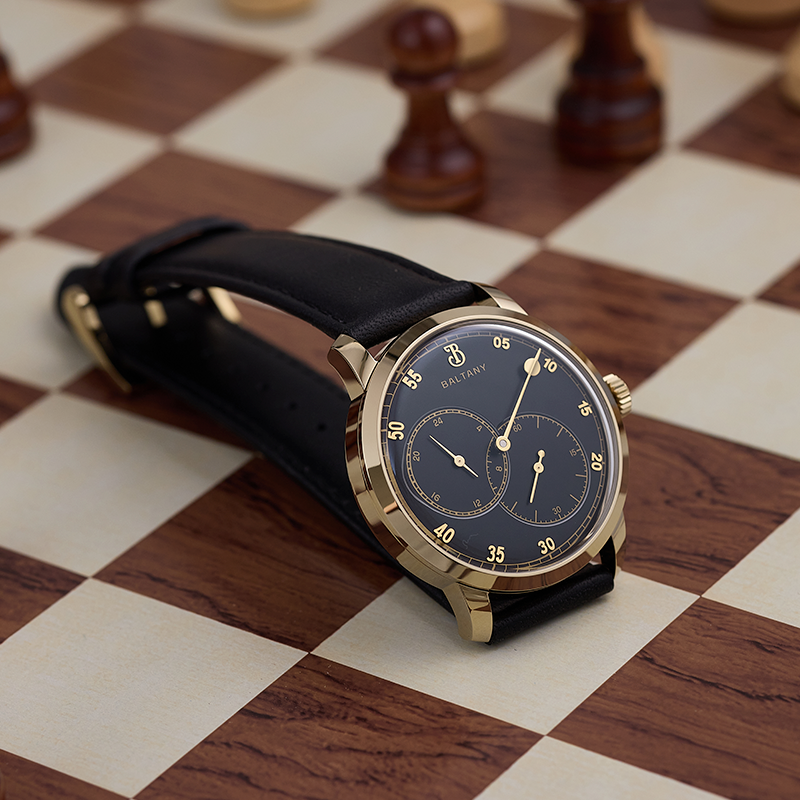
Our original take on a regulator-style layout, built around a deliberately asymmetric composition: instead of the conventional 3, 6 or 9 o'clock placement, the small seconds sits at 5 o'clock.
The minute hand is a butterfly design, and in motion it genuinely reads like a butterfly drifting across the dial.
There's more going on beneath this one than the layout suggests — including what we had to do about the calibre's original hand configuration.
We've written about it in full here: Read the full story.
May 2026 — The S4099
A micro-rotor movement, which does two jobs at once: it slims the case substantially compared with a full-rotor automatic, and it opens up the movement architecture visually so there's something worth looking at through the caseback.
The dial is finished in Clous-de-Paris hobnail — a pattern very few brands at any price attempt, because the pyramid field has to be perfectly regular across the entire surface or the eye picks up the error instantly.
It became a fast seller.
Full details here: Read the full story.
The Point of All This
None of what we've described here will show up in a side-by-side spec comparison.
The hardening, the hand-finished transitions, the bracelet tolerances, the full lume fills, the five-position regulation, the custom no-date movement — they all cost us money and time, and they're all invisible until the watch is on your wrist.
That's exactly why we do them.
Details decide everything.
A watch is not a list of materials; it's the sum of a few hundred decisions about how carefully to make something.
Baltany will keep doing what we've always done — bringing vintage design language back with real conviction — and we'll keep pushing our own manufacturing standard forward underneath it.
Same philosophy, better and better execution.
Read More
1. Baltany S4108: A Quiet 1930s Order, Read in the Palm of Your Hand
2. A Clous-de-Paris Micro-Rotor Dress Watch Reimagined for Modern Collectors - Baltany S4099
3. Baltany S101: The Art of Subtlety – Hidden Details That Elevate the New Dress Watch
4. Baltany Retro Diver S3026 — Design, Specs & Features