Shopping cart is empty.
Total (USD):$10.00
Checkout
 $ USD
$ USD
Baltany S4129: The Datejust Tribute That Kept an Older Kind of Sparkle
Introduction
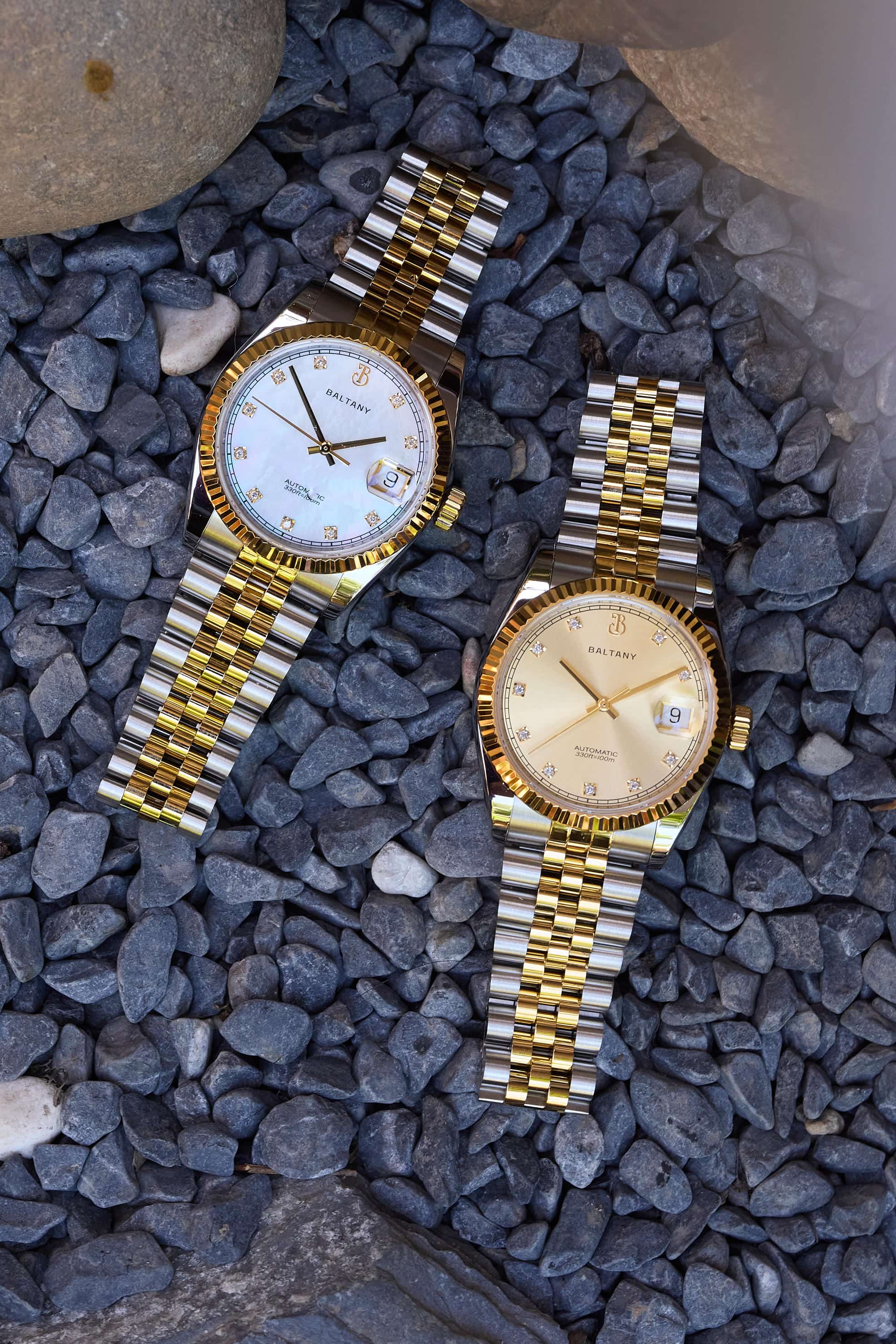
There's a particular kind of sparkle that only shows up on watches made before a certain point in Rolex's history — a sparkle where the stone itself, not the metal around it, is what catches your eye first. Somewhere in the mid-1990s, that changed. The Baltany S4129 is our attempt to bring the older version back.
Here's the honest version of what this watch is: on the surface, the S4129 is a straightforward tribute to the modern Datejust with a diamond dial and Jubilee bracelet — a fluted bezel, a cyclops date, a five-link bracelet, the whole familiar silhouette. We didn't set out to reinvent that shape, and we won't pretend we did. What we did do is make one deliberate, slightly stubborn decision about how the stones sit on the dial, and that decision is the reason this watch exists at all.
We wanted a diamond Datejust tribute that a real collector would look at twice — not because it does something new, but because it does something old, on purpose, in a place where almost nobody else bothers to.
The Era the Setting Comes From
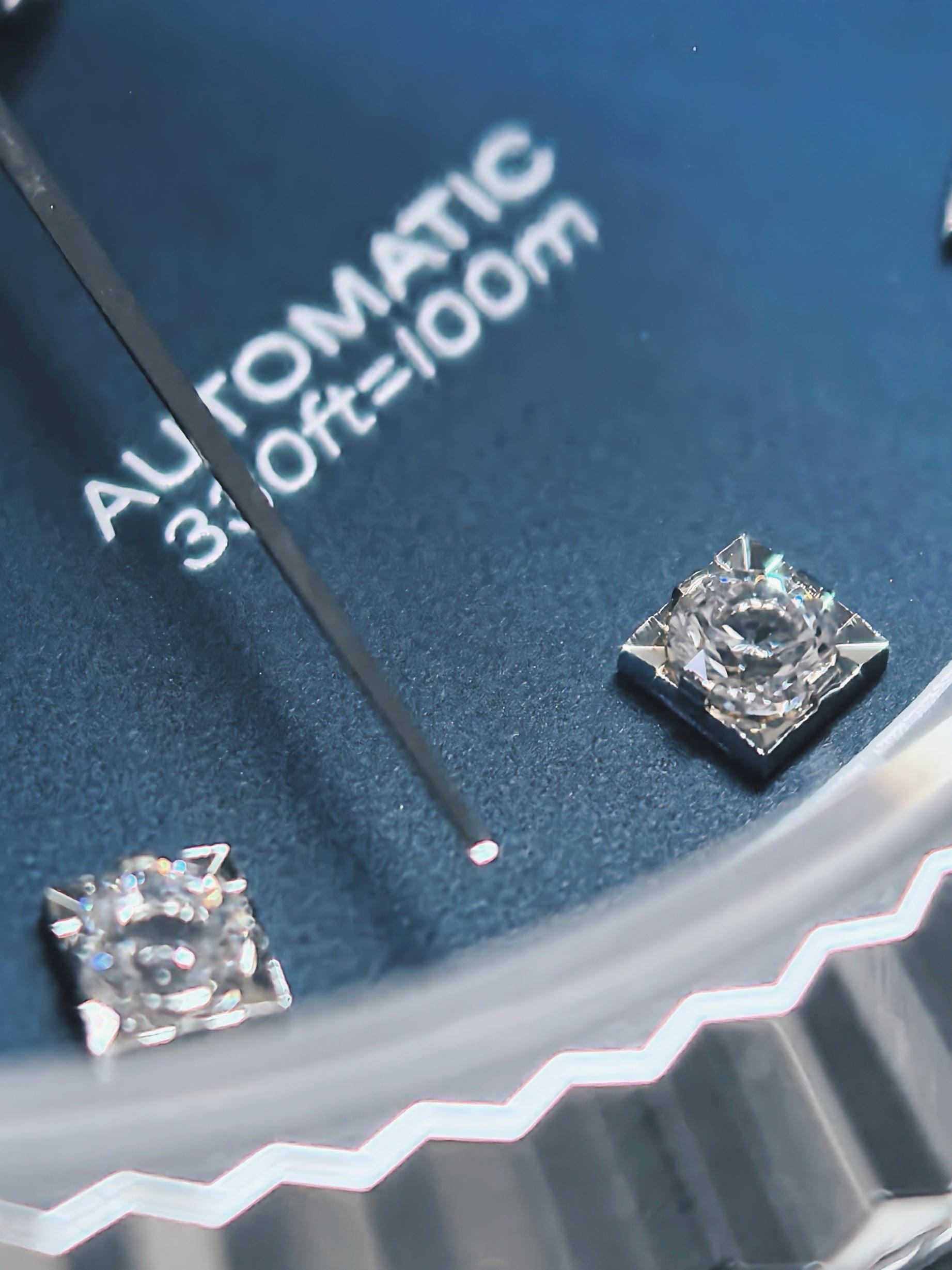
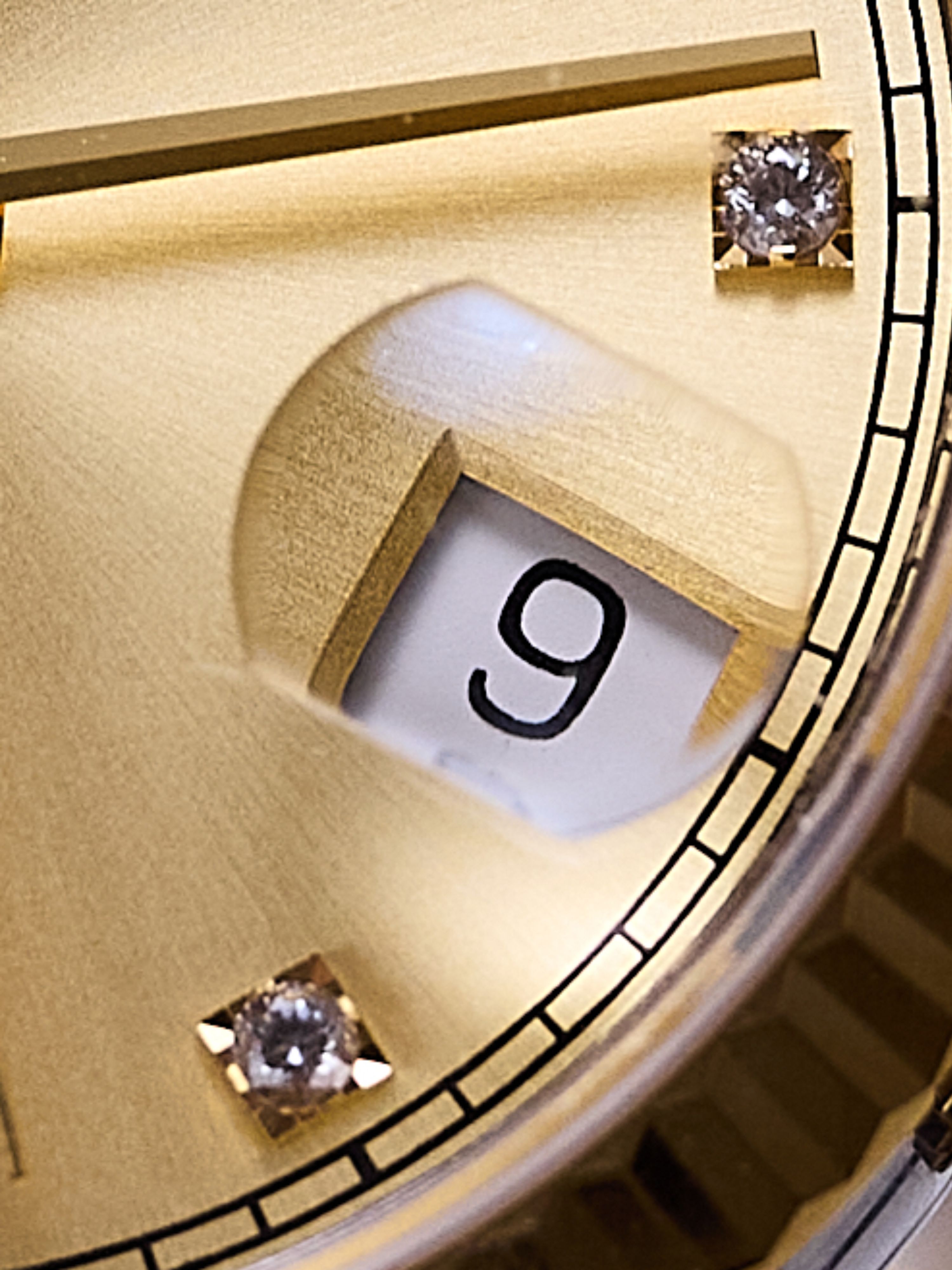
Every collector who has spent time around Rolex diamond dials knows a small tell: look at how the stone sits in its setting. On watches made before roughly the mid-1990s, the metal claw holding each stone is small — sized to match the stone itself, so the stone sits almost flush with the dial, exposed on nearly all sides. On watches made after that point, Rolex moved to a larger claw that wraps further around the stone, framing it more heavily in metal.
It's a small thing. It's also, for people who know what they're looking at, one of the fastest ways to tell an older diamond-dial Datejust from a newer one without even checking the reference number. Datejust diamond dials themselves go back decades — Rolex has offered gem-set dial options across many generations of the reference — but the *way* those stones were set changed at that mid-90s line, quietly, the way a lot of manufacturing details change without anyone announcing it.
We were drawn to the earlier version. Not because it's more valuable or more "correct" — it isn't, and we don't want to oversell that point — but because it's a different visual language. The stone reads as the subject. The metal is just the frame.
The Reference and Baltany's Reinterpretation
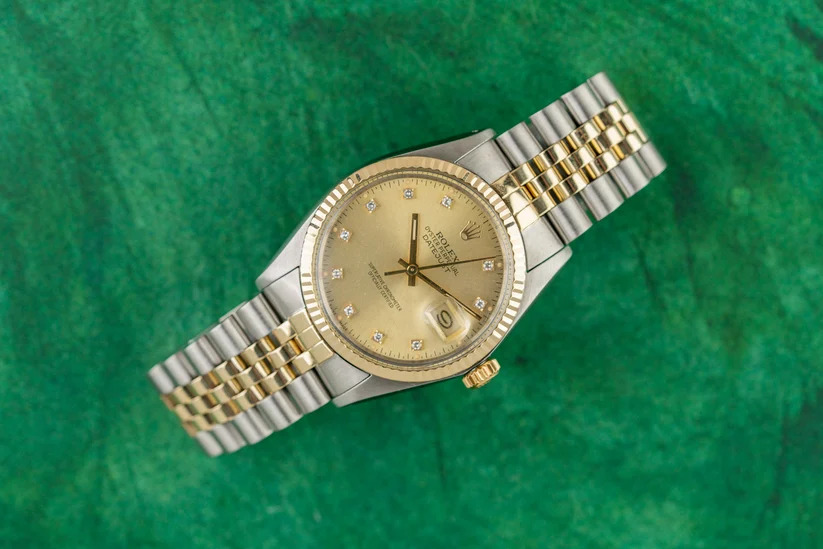
The shape S4129 pays tribute to is the current-production Datejust — specifically the kind of white mother-of-pearl, diamond-marker, Jubilee-bracelet configuration most recognizable in references like the 126234 and 126231. That's the silhouette: 36mm case, fluted bezel, cyclops lens over the date, five-link Jubilee bracelet.
What we changed is the one detail described above. Modern factory Datejust diamond dials use a larger claw setting. We had our own small-claw setting tooled from scratch, sized to sit flush with the stone rather than wrap around it. This wasn't a part we could source off the shelf — every gem-setting component currently manufactured for this category is built to the modern, larger-claw standard, because that's what current Rolex production uses and what every other Datejust tribute on the market copies. Getting the smaller setting meant commissioning new tooling specifically for this one detail.
We want to be direct about why we think this matters, and where it doesn't:
- It isn't a technical improvement. Rolex's move to the larger setting in the 1990s wasn't arbitrary — a bigger claw holds the stone more securely, wears better over decades, and gives a more uniform dial surface. There are real, practical reasons the industry moved that direction.
- It is an aesthetic and historical choice. We simply prefer how the earlier setting looks, and we think there's an audience who agrees — people who already know Datejust history well enough to notice the difference without being told.
- It's the detail that made this watch worth making. Every other Datejust tribute with diamonds on the market uses the modern large-claw setting, because that's the part that's actually available to buy. S4129 is, as far as we've found, the only one in this category that went the other way.
Prototype vs. Baltany S4129
| Case size & bracelet | 36mm, Jubilee bracelet, fluted bezel | Same |
| Diamond setting | Modern large-claw setting (claw larger than the stone) — current factory standard, copied by most tribute watches | Custom small-claw setting, re-tooled to match the stone size, echoing the pre-mid-90s look |
| Visual effect | Stone framed and partly covered by metal; metal reads as the dominant element | Stone sits closer to flush, more exposed; the stone reads as the dominant element |
| Case thickness | 12mm | 10.8mm |
| Water resistance | 100m / 10ATM | 100m / 10ATM |
Design Focus — The Dial
The dial is where the whole argument for this watch either lands or doesn't, so we spent the most time here.
We offer S4129 in four dial colors: a warm champagne dial on the two-tone gold-and-steel case, a deep black dial, a white mother-of-pearl dial, and a blue sunburst dial. Ten faceted hour markers sit around each dial — man-made cubic zirconia (CZ) stones, not diamonds, and we say that plainly rather than let the word "gem-set" do any misleading work. What makes them worth looking at isn't the material; it's the setting we described above. Because the claw is small and matched to the stone, each marker catches light as a distinct point rather than as a stone-in-a-frame. On the white MOP dial in particular, the effect plays well against the dial's natural shimmer — two different kinds of light doing two different things at once.
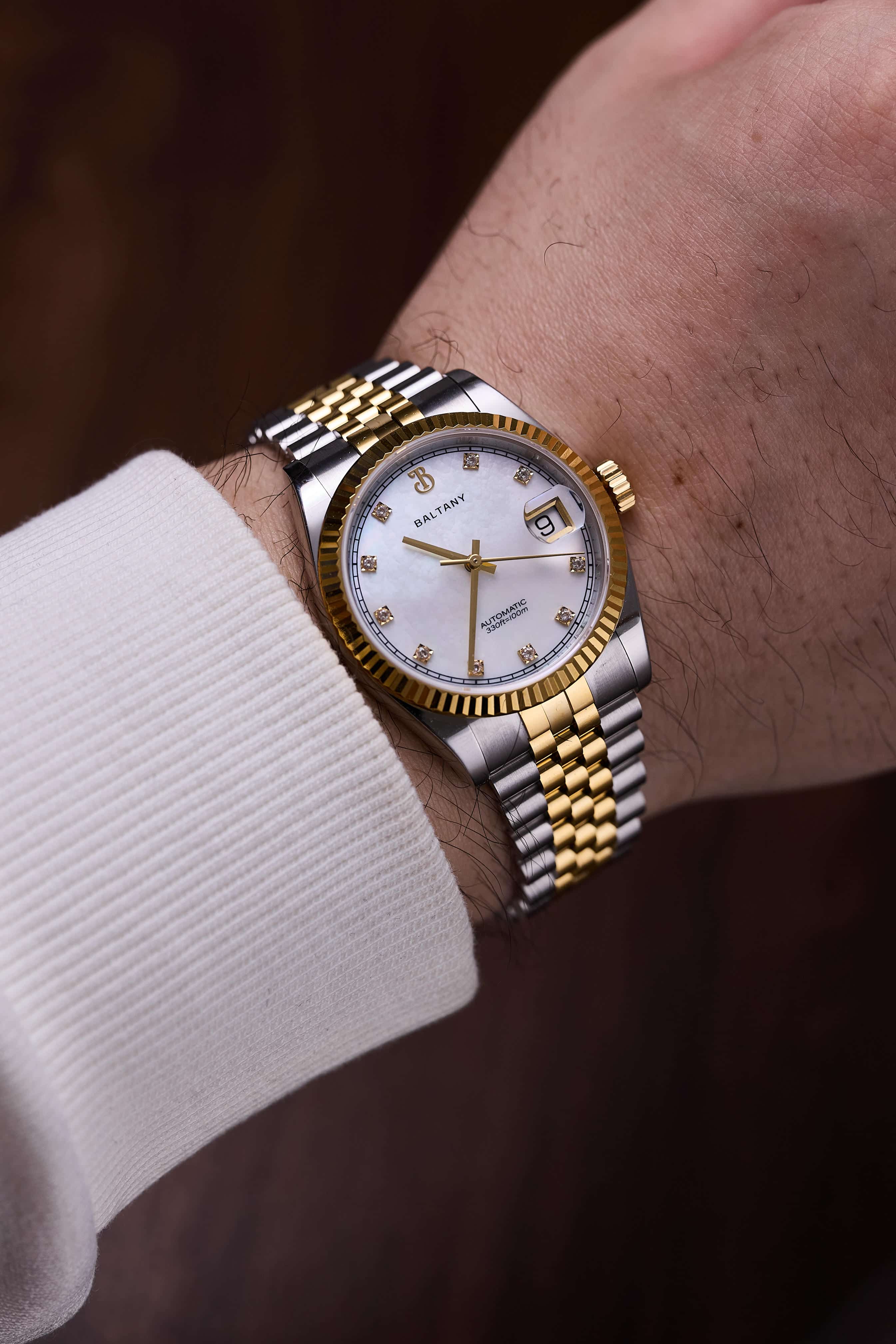
We kept the layout otherwise close to the familiar Datejust reading: an applied "B" monogram at 12 in place of a marker, "BALTANY" printed beneath it, a cyclops-magnified date window at 3, and slim polished baton hands. We didn't add texture, sunburst effects beyond the blue dial's natural finish, or extra text — the crystal are the visual event, and we didn't want to compete with them.
One small, deliberate choice: we kept the date wheel legible without over-magnifying it, so the cyclops lens does its job — a nod to the vintage Datejust reading experience — without turning the date into a distortion.
Craft and Specifications
The movement is an ST2130 automatic(In mid-2026, due to a shortage of NH movements, we gradually began replacing the movements used in our production line with domestically manufactured movements.), built on the widely used 2824 architecture, running at 28,800 vph (4Hz) rather than the 21,600 vph (3Hz) more common in this price category. We chose it for two practical reasons rather than a marketing one: the higher frequency gives the seconds hand a noticeably smoother sweep, and because the 2824 architecture is so widely serviced, parts and repairs are easier to source than on some of the movements typically found in Datejust-style tributes.
The crystal and case stay close to the reference: a fluted bezel, a cyclops lens over the date at 3 o'clock, and a case that comes in at 10.8mm thick — on the slimmer side for a diamond-dial tribute in this category, where thicknesses in the 12–15mm range are common.
Water resistance is rated to 100m, which comfortably covers daily wear, handwashing, and swimming, without us dressing it up as a dive-rated figure it isn't.
Specifications
- Movement: ST2130 automatic (2824 architecture), 28,800 vph / 4Hz
- Case material: 316L stainless steel (two-tone option in gold IP)
- Diameter: 36mm
- Thickness: 10.8mm
- Lug-to-lug: 43.5mm
- Water resistance: 100m / 10ATM
- Crown: screw-down
- Crystal: sapphire, with cyclops date magnifier
- Bezel: fluted
- Hour markers: 10 faceted CZ (cubic zirconia) stones, custom small-claw setting
- Dial colors: Champagne (two-tone), Black, White MOP, Blue
- Bracelet: five-link Jubilee-style
- Warranty: 2 years
Who It's For
We didn't design S4129 for someone shopping for their first watch. We built it for someone who already knows enough Datejust history to clock the setting difference without a caption — the kind of person who'd pick up a diamond-dial tribute, glance at the hour markers, and either nod or say nothing at all.
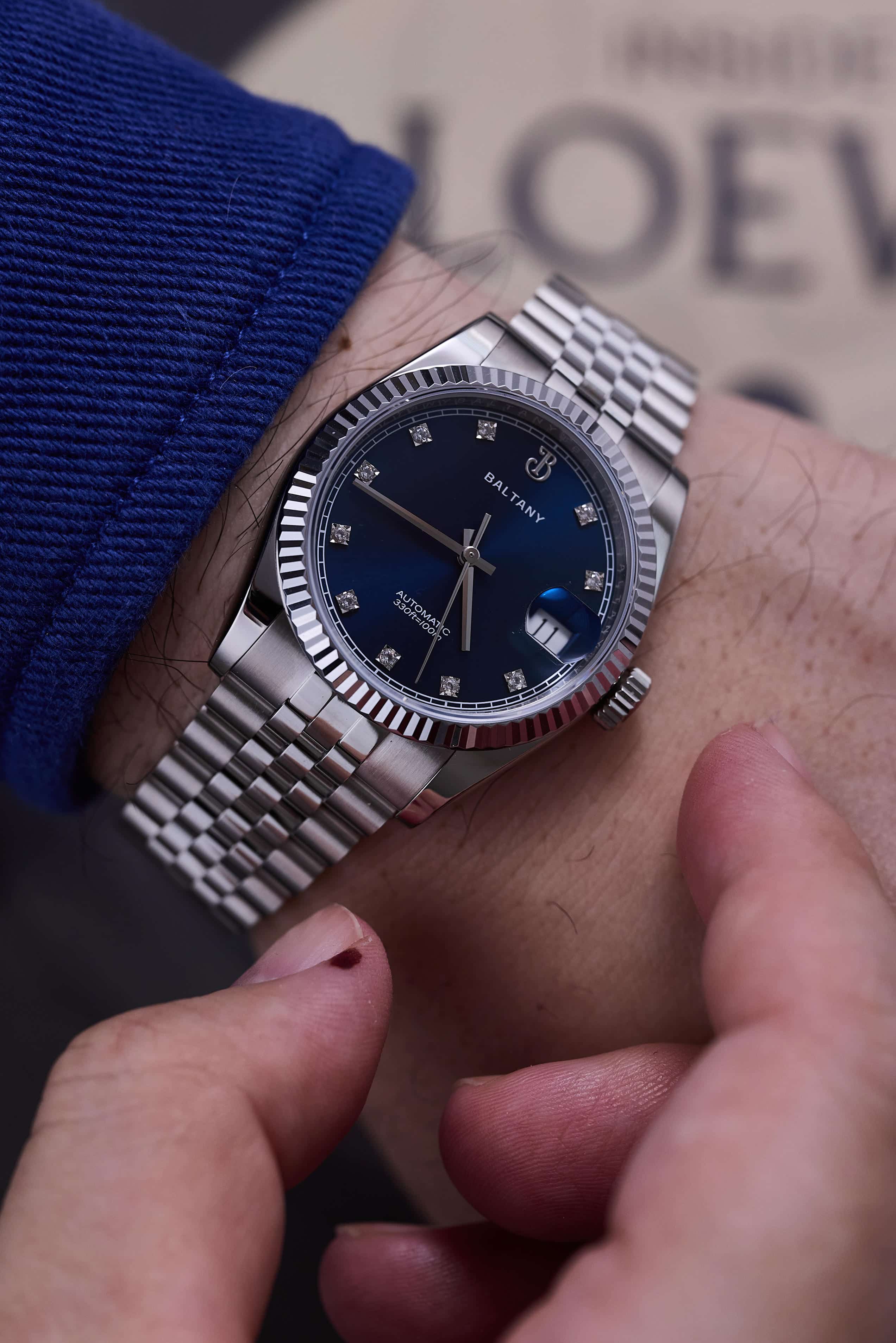
Practically, that person is usually choosing a 36mm case on purpose, not by default. General consensus among long-time Datejust wearers — echoed across — is that 36mm comfortably suits wrists from roughly 6.5 to 8 inches, and that a slimmer case height (S4129 sits at 11mm) keeps the proportions from tipping into "small" even on a fuller wrist. We'd add our own note: on a Jubilee bracelet specifically, the wrist presence reads a little larger than the diameter alone suggests, because the multi-link bracelet fills more of the wrist's visual width than a plain strap would.
A few real-world reference points:
- Wrist circumference around 6–6.5 inches (slim to average): the 36mm case and Jubilee bracelet sit close to the classic "correct" Datejust proportion — nothing swims, nothing overhangs.
- Wrist circumference around 7–7.5 inches (average to fuller): still comfortably wearable; the case reads as a deliberate smaller-format choice rather than an ill fit, especially with the bracelet's visual width.
- Wrist circumference above 8 inches: this is where a 36mm case starts to read as intentionally minimal rather than proportionate — still wearable, but you're choosing the look over a size-matched fit.
On the bracelet: the five-link Jubilee that ships with S4129 is the setup we'd recommend keeping — it's part of the reference silhouette, and swapping it for a leather strap undercuts the exact look this watch is built around. If you do want a second option for casual days, a plain steel mesh or a simple black leather strap in 20mm keeps the dial as the focal point without fighting the two-tone or gold accents. We wouldn't reach for a NATO or a rubber strap here — the whole point of this watch is a dressier, jewelry-adjacent register, and a casual strap works against that.
H2: FAQ
Q1: Is 36mm too small for a men's watch?
A: Not inherently — 36mm was the standard Datejust size for decades, and puts it as comfortable on wrists up to roughly 8 inches, especially paired with a Jubilee bracelet, which adds visual width. Above that, it becomes more of a style choice than a proportion match. We don't have in-house wrist-shot data across every wrist size yet — if you want a closer look before buying, the product page carries additional photos.
Q2: Are the stones on this watch real diamonds?
A: No. The hour markers are man-made cubic zirconia (CZ), not diamonds. That's reflected in the product name and price, and we'd rather be clear about it here than let "gem-set" imply otherwise.
Closing
We opened this piece with a small, specific claim: that somewhere in the mid-1990s, the way stones sat on a Datejust dial quietly changed, and that most people never noticed because most people were never meant to. S4129 is built for the ones who did notice. Everything else on this watch — the case, the bracelet, the bezel — is a faithful, straightforward tribute. The setting is the one place we chose to look backward instead of copying what's currently on the shelf.
We're not going to tell you that makes it better. We'll just tell you it's the reason we built it.
Purchase Information
- Release date / timezone: 2026.8.18
- Price / currency: $264-$290
- Duties / import tax note: Here to Learn More
- Bracelet included: five-link Jubilee-style, stainless steel (two-tone on gold colorway)
- Warranty period: 2 Years
- After-sales contact: support@baltanyofficial.com
- Product page: [baltany.com/product/cz-gemset-hour-markers-36mm-dj-homage-watches-s4129]
Read More
1. Details You Can't See on a Spec Sheet: Inside Baltany's Craft
2. Baltany S4128: A Micro-Rotor's Quiet Return to 1960s Dress-Watch Elegance
3. Baltany S4107: A Pure No-Date Pie-Pan Dress Watch Inspired by Mid-Century Elegance
4. Baltany Retro Diver S3026 — Design, Specs & Features
5. Classic Vintage Pie Pan Timepieces Reinvented - Baltany S4090